
A coach emailed me last Tuesday. Subject line: "Carsten, am I screwed?"
She's been writing blog posts for four years. Three of them rank on Google for anything searchable. None of them rank for anything that actually brings her clients. She just heard that ChatGPT is "taking over search." She's wondering if she should keep writing at all.
I get this email almost every week now. Sometimes the worry is bigger ("AI is going to kill my business"). Sometimes it's smaller ("do I need to start over?"). The underlying question is always the same: did I just spend the last few years building something that's about to be useless?
Here's the honest answer: no.
But the game changed.
Let me tell you what's actually happening, what to do about it, and what to safely ignore.
The Headline Numbers Don't Tell the Real Story
When you read marketing news, the picture looks apocalyptic. ChatGPT has over a billion users. AI Overviews answer questions inside Google's search results so users never click. Gartner predicts traditional search volume will drop 25% as users shift to AI. Half the X accounts in the SEO space are saying "content is dead."
If you stop reading there, you should panic.
But the same week those headlines drop, Google still handles around 90% of all searches globally.
Total search volume is still growing roughly 10% year over year. Helpful Content Update aside, smaller focused sites with real expertise are getting cited more, not less.
Half the SEO accounts on X are also saying organic traffic is the best it's ever been for the right kind of content.
Both camps are right. They're just talking about different content.
What's Actually Happening
Two things shifted at the same time, and you need to hold both in your head to make sense of any of this.
Shift one: AI is now the front door for some questions. When somebody asks "what's the best executive coach for tech founders in Toronto," that question increasingly gets answered by ChatGPT or Gemini, with a generated answer that mentions a small number of brands. The user never goes to Google. They never see your site, even if you rank #1 on Google for that exact phrase.
Shift two: Google itself uses AI now. Inside the regular Google results page, the algorithm reads your content directly. It evaluates whether your sections actually answer the question. It detects who said something first. It rewards genuine expertise and punishes generic content much harder than it used to.
These two shifts get bundled together as "AI search," which is why the conversation is confusing. They're different problems with different solutions.
If you only think about shift one (AI engines like ChatGPT), you start panicking that organic content is dead.
If you only think about shift two (Google getting smarter), you keep doing 2018 SEO and wonder why your competitors are showing up in ChatGPT and you aren't.
The coaches I work with mostly need to think about both.
The Number That Should Make You Stop and Think
Last month I went deep on a study Neil Patel's agency NP Digital published. They tracked which brands get cited in AI answers across 500 commercial keywords and over 4,000 prompts. (His video walking through it is here.)
A year ago, around 76% of ChatGPT citations came from sources that ranked in Google's top 10. Today that number is closer to 38%, and falling. Three out of four AI citations now come from sources that don't appear in Google's top results at all.
Translation, in coach language: you can rank #1 on Google for "executive coaching for tech founders" and ChatGPT might recommend three other people when someone asks for one.
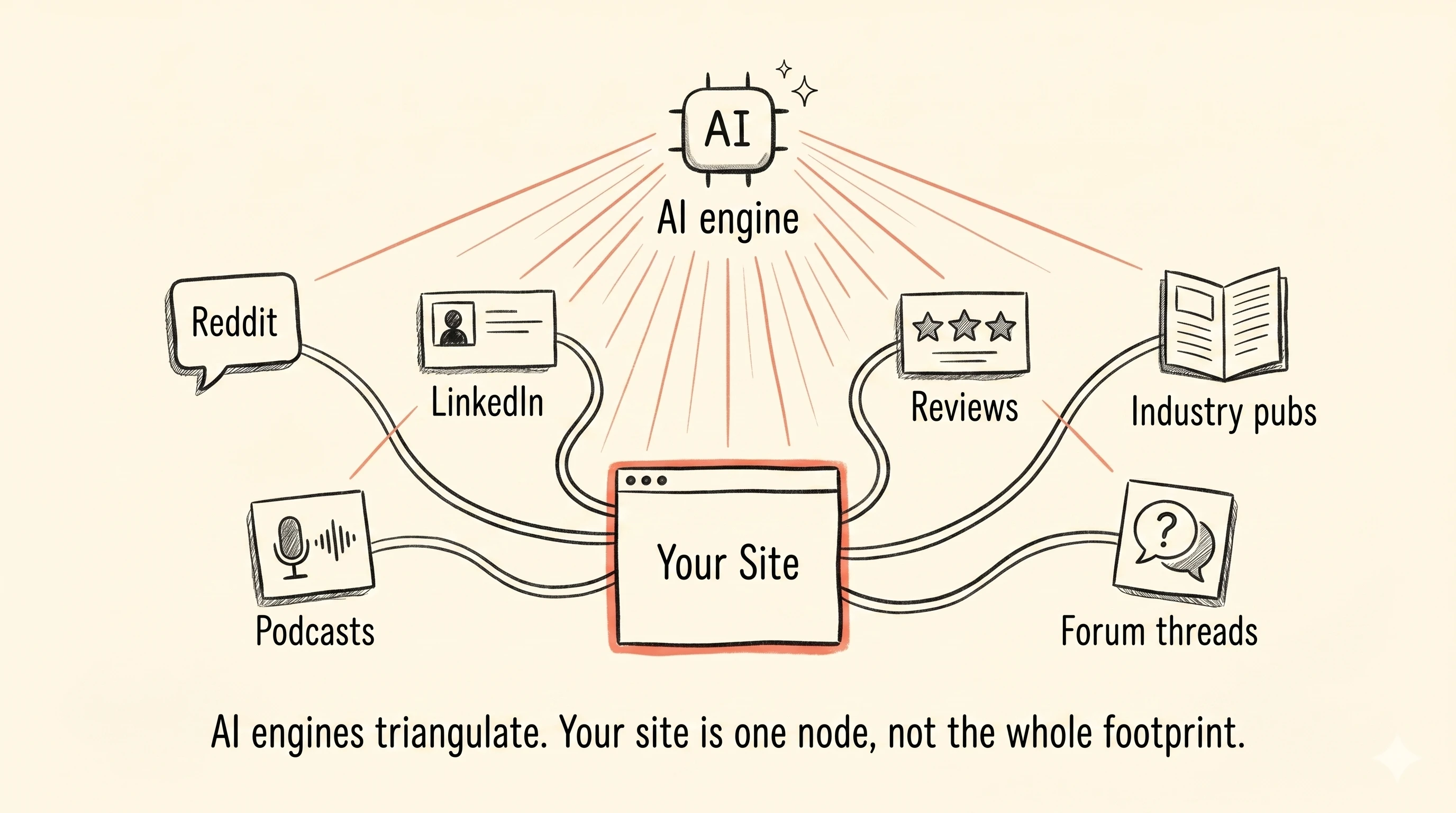
This isn't because Google is broken or because ChatGPT is biased. It's because they use different retrieval logic. Google decides who ranks based on its index. ChatGPT decides who to cite based on its own pool of sources, which leans heavily on Reddit, LinkedIn, podcast transcripts, third-party reviews, and niche industry publications. If those surfaces don't mention you, ChatGPT has nothing to draw from.
Your website is one node. AI engines look at the whole web.
Should You Keep Writing Blog Posts?
Yes. With three caveats.
One: stop chasing volume. If your reaction to "AI is changing search" is to write more posts faster, you're misreading the shift. Generic content is exactly what AI absorbs without citing. Restating what other people already said is exactly what gets ignored. The bar is now genuinely useful, original, expert content. Less of it, but actually better.
Two: structure your content so AI can extract from it. This is the one craft change that matters most. AI engines don't read your page top to bottom and decide whether to recommend you. They scan sections looking for clean, extractable answers. If your sections don't contain a clean answer in the first two sentences, the AI skips them. Even if the rest of the section is excellent.
A simple test: take any section of your latest blog post. Can the main point be stated in two sentences without losing context? If yes, an AI engine can quote it. If no, it gets passed over.
Three: stop thinking your website is the entire footprint. This is the hardest mindset shift for coaches who've been told for years to "focus on your blog." Your site is still the home of your best content. But AI engines triangulate. They check who else mentions you, in what context, on what platforms. A coach with 30 mediocre blog posts and zero off-site presence has lower AI visibility than a coach with five great pages plus consistent presence on LinkedIn, plus a niche podcast appearance, plus a few authentic Reddit answers in their domain.
The work isn't 10x more. It's different work, weighted differently.
What I'd Actually Do This Week
If I were a coach reading this and wondering where to start, I'd do three things.
Audit where your prospects actually go. Pick your last five clients. Ask each of them, in your next conversation: "Where did you go when you first tried to figure out how to solve [the problem you helped them with]?" Don't lead with "ChatGPT or Google?" Let them tell you. Some will say a friend. Some will say Reddit. Some will say a colleague's recommendation. A growing number will mention an AI engine without prompting. That answer tells you which surfaces matter for your audience right now.
Run your top three pre-purchase questions on ChatGPT. Not your branded terms. The questions someone asks before they know you exist. "Best executive coach for tech founders." "How to find a coach for first-time CEOs." "What does executive coaching actually cost." Whatever your equivalent is. See what gets cited. Are you in any of the answers? Are sources you've never thought about being cited?
Pick one thing to fix. Don't try to overhaul everything at once. Either improve the structure of your top page so each section is independently quotable, or pick one off-site surface (LinkedIn, a niche podcast, a relevant subreddit) where you'll show up consistently for the next six months. One thing, sustained. Not five things abandoned.
The coaches I work with who pick one thing and stick with it for six months always end up better positioned than the ones who chase every new AI tool.
What to Safely Ignore
The "AI SEO" or "GEO" or "AEO" industry that's emerging right now is mostly selling solutions to a problem Google itself says doesn't exist.
Google's own documentation says directly: "There are no additional requirements to appear in AI Overviews or AI Mode, nor other special optimizations necessary." There's no schema trick. No llms.txt file you can add. No magic markup. Even insiders in the GEO industry admit attribution is "a black hole" and that most of what's being sold as AI optimization is guessing.
If a tool is pitching you that they'll get you cited in ChatGPT for $200 a month, ask them how. Most of the answers are some version of "we publish more content for you." That's not solving the problem. It's adding to the noise problem.
The things that work for AI engines are the same things that work for Google: clarity, depth, structure, genuine expertise, and presence on the surfaces where your audience actually engages. There's no separate playbook to buy.
Back to the Coach Who Emailed Me
I wrote her back. Told her she's not screwed. The four years of blog posts aren't wasted, but they're probably not optimized for the new landscape either. We talked about three things to focus on for the next quarter: restructuring her two highest-traffic posts so each section has a clean two-sentence answer at the top, getting her on a podcast in her niche, and answering questions consistently in one specific subreddit where her ideal clients hang out.
She didn't need a new tool. She didn't need to learn "AI SEO." She needed to look at her existing work with fresh eyes and add one new thing.
That's what I'd tell most coaches who email me with the same worry. Google isn't dying. It's getting more demanding. AI isn't replacing organic content. It's adding a new layer that rewards expertise and punishes generic. The work that compounds is the work that was always going to compound. The work that wouldn't compound is the work that's now visibly failing because the algorithm can finally tell the difference.
You're not behind. The bar moved. You just need to know where it moved to.
I built SitePerfector to help coaches and other solopreneurs handle the on-site half of this. It plans your content so each post connects to a strategic theme. It structures your articles so each section is independently quotable for both Google and AI engines. And it tracks how your pages rank on Google over time, so you can see what's actually compounding. If you want to try the system I described above, you can check it out here.
*P.S. The structure of this article, including the section breaks designed for AI extraction, was planned with SitePerfector.