
A client of mine, a leadership coach in Toronto, sent me this last month: "My peer Lisa keeps showing up in ChatGPT recommendations when people ask for executive coaches in our city. I don't. We have similar credentials, similar websites, similar everything. What's she doing that I'm not?"
I see this exact pattern across the coaches I work with. Two practitioners, same niche, same level of experience, very different AI visibility. The difference isn't talent. It isn't budget. It isn't even who has more blog posts.
It's three structural things, and almost nobody is teaching them clearly to coaches yet.
Let me walk you through what they are, why they matter, and what to do about each one this week.
First, What This Article Isn't
This isn't a pitch for "AI SEO" or "GEO" or "AEO" or whatever the acronym of the month is.
The "AI optimization" industry that's been emerging over the last year is mostly selling you the equivalent of a magic SEO pill. There's no schema trick that gets you cited in ChatGPT. There's no llms.txt file that flips the switch. Google's own documentation says directly that no special markup is needed for AI features. Even insiders in the GEO space admit attribution is "a black hole" and that most of what's being sold is guessing.
If a tool is pitching you a $200 monthly fee to "optimize for AI search," ask them how. The answers are usually some version of "we'll publish more content for you" or "we'll add some metadata." Neither of those is the actual lever.
The actual levers are three structural things. None of them require a tool. All of them require you to think differently about your content and your presence.
The Real Difference Between Lisa and Her Peer
Lisa, the coach who keeps showing up in ChatGPT, isn't doing anything weird. She's not paying for "AI SEO." She isn't gaming the system. She's just doing three things that her peer happens not to be doing.
Once you see them, you can't unsee them.
One: Quotability Is Now a Structural Property of Your Content
Here's the most concrete craft change in 2026, and it's not subtle.
When somebody asks ChatGPT "who are the best executive coaches in Toronto," the model doesn't read entire websites and decide whom to recommend. It scans sections of pages looking for cleanly extractable answers. If a section answers the question in roughly the first two sentences, the model can quote it. If the answer is buried six paragraphs in, the model skips that section entirely, even if the rest of the content is excellent.
This is mechanical. Models break content into chunks, score each chunk for relevance to the query, and pull the best-scoring chunks into the answer. If your chunks don't contain self-contained answers, they don't score.
Most coach websites fail this test in a predictable way. The home page reads like a brochure. The "About" page tells a story that builds to the conclusion in the last paragraph. The blog posts open with three paragraphs of context before getting to the actual point.
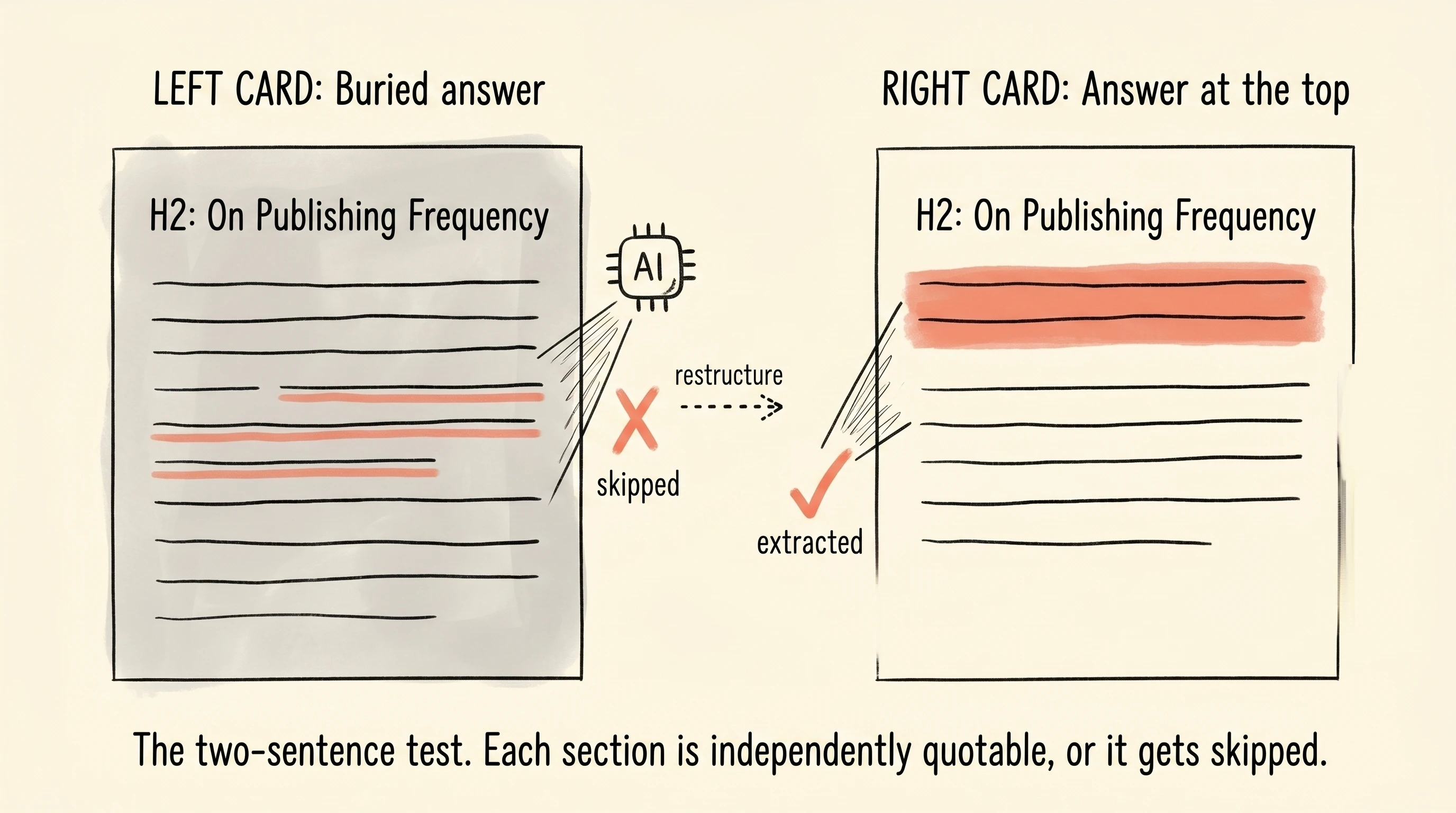
Lisa's site, looking at it honestly, doesn't have this problem. Her "Who I Work With" section opens with: "I work with first-time CEOs in tech companies between Series A and Series C, typically at the moment they realize their leadership style needs to evolve from founder to operator." Two sentences. Self-contained. ChatGPT can quote it cleanly when someone asks "who works with first-time tech CEOs as a coach."
Her peer's "Who I Work With" section opens with three paragraphs about the coach's personal philosophy before mentioning who she actually serves. The answer is in there. It's just buried.
Same information. Different structure. Vastly different AI extraction.
The fix is one round of editing per page. Read each section. Apply this test: can the main point be stated in two sentences, near the top, without losing context? If no, restructure. Move the answer up. Trim the wind-up. The information stays the same. The order changes.
Two: Your Domain Is the Anchor, Not the Entire Footprint
This is the harder shift for most coaches.
Traditional SEO trained us to think domain-first. Build authority on your site. Earn backlinks to your site. Rank with your site. The site was the work.
AI engines don't work that way. They cross-reference. When somebody asks ChatGPT for executive coach recommendations, the model isn't just checking which sites rank for that query. It's checking what the rest of the web says about each candidate. Reddit threads. LinkedIn discussions. Podcast appearances. Third-party reviews. Industry publications. Niche newsletters. Comments under articles. All of it.
A coach with a great website and zero off-site presence generates low confidence. The model can't verify what your site claims about you if no one else mentions you in connection with that claim.
Lisa's footprint isn't massive. She isn't on every podcast. She isn't a Reddit power user. But she does three off-site things consistently:
She posts on LinkedIn weekly with substantive opinions about leadership at growth-stage tech companies. Specific opinions, with specific examples, that other people in the industry comment on and share.
She's been on three niche podcasts in the last year. Not big-name podcasts. Specific podcasts hosted by other people in tech leadership development, where her perspective shows up alongside people her ideal clients already trust.
She answers questions occasionally in one specific subreddit where founders ask about coaching. Not promotional. Genuinely useful. Maybe once a month.
That's it. Three surfaces, sustained for over a year. The cumulative effect is that when ChatGPT looks for "executive coaches who work with first-time tech CEOs," her name shows up across multiple independent sources, in consistent context. The model has reasons to trust the citation.
Her peer has none of this. Great website. Probably better written, even. But no off-site echo. The model has no second source to triangulate against.
The fix isn't to be everywhere. It's to be consistently present on the two or three surfaces where your specific clients actually engage. For most coaches I work with, that means LinkedIn (for B2B coaches), one or two niche podcasts per year, and one community where their ideal clients hang out. Sustained over six to twelve months. Not a campaign. A practice.
Three: Different AI Engines Pull from Different Pools
This is the one that surprises most coaches.
People talk about "AI search" as if ChatGPT, Gemini, Claude, and Perplexity are the same thing. They're not. Different user bases. Different source pools. Different citation behavior. A brand cited consistently by ChatGPT might be invisible on Gemini, dominant on Perplexity, and never mentioned on Claude.
This matters because your customers are not all on the same engine.
For coaches working with B2B clients, Gemini matters more than people realize. It's tied to the Google ecosystem, which means anyone living in Google Workspace (most of corporate America, frankly) hits Gemini whenever they ask Google a question. Many of your potential clients are asking Gemini "how do I find a leadership coach for my engineering managers" without ever opening ChatGPT.
For coaches working with technical clients (CTOs, dev leaders, engineering managers), Claude is disproportionately important. Claude skews technical and analytical. Engineering leaders use it. Your visibility there matters more than your visibility on consumer-skewed ChatGPT.
For coaches working with consumer-facing clients, ChatGPT and (increasingly) Meta AI cover most of the surface area.
If you only audit your visibility on ChatGPT, you're missing where many of your clients actually ask their pre-purchase questions.
The fix is to know which engine your clients actually use. Don't guess. Ask in your next five sales calls: "Where did you go when you first tried to figure out how to find a coach for [their specific situation]?" Don't lead with "ChatGPT or Google?" Let them tell you. Many will name an engine you didn't expect. Some will say "I asked someone in my network." That's signal too.
After five conversations you'll have a clearer picture of where your audience starts their research than any tool can give you.
Sarah's Three Months
Let me walk you through what this actually looks like in practice. The names are changed but the pattern is real.
Sarah is a leadership coach in Toronto. Strong credentials. Well-designed website. Ranked top five on Google for her core terms. Zero AI mentions for any query her ideal clients would actually ask.
We focused on three things over twelve weeks.
Weeks one to four: structural rewrite. We took her four highest-traffic pages (home, about, who-I-work-with, services) and applied the two-sentence test to every section. Most sections needed the answer moved to the top. We added clear H2 headings that mirrored real questions ("Who I Work With" became "Who I Work With: First-Time CEOs in Tech Companies"). Each section now stood alone, extractable, in the first two lines.
Weeks five to eight: one off-site channel. We picked LinkedIn because that's where her clients live. She started posting twice a week, substantive opinions on leadership transitions in growth-stage tech companies. Not generic motivational content. Specific takes that other people in the field engaged with.
Weeks nine to twelve: one podcast plus one community. She got booked on one niche podcast hosted by someone her ideal clients already follow. She started answering one founder question per week in a specific subreddit where her ideal clients hang out, only when she had something useful to say.
By week twelve, she was getting cited in ChatGPT for two of her core queries. Gemini took longer. Claude wasn't picking her up yet. We adjusted from there.
What didn't matter: she didn't buy any AI optimization tools. She didn't add schema. She didn't change her domain or her hosting. She didn't even publish that many new blog posts. The structural changes plus the off-site presence did most of the work.
What to Actually Do This Week
Three actions, in order, none of which require a new tool.
Run the audit. Pick three pre-purchase questions your ideal clients ask. Run them on ChatGPT, Gemini, and Claude. Note where you appear, where you don't, and which sources are getting cited that you could be in. This takes less than an hour and tells you more than most paid tools.
Pick the lowest-effort fix. Don't try to do all three pillars at once. If your site has structural issues, fix that first. It's the cheapest change with the highest leverage. If your site is already cleanly structured, pick one off-site surface where your clients actually engage and start showing up there consistently.
Commit for six months. This is the part most coaches skip. Whatever you choose, do it long enough to compound. Six months minimum before you check the result. AI visibility builds slowly because it's a function of what the whole web says about you, and the web doesn't update overnight.
You don't need a campaign. You need a practice.
Back to Lisa's Peer
I sent my client a version of what I just walked you through. She did the audit. She picked structure as the first fix because her site was the most fixable thing. Two months in, she had restructured all her pillar pages and started showing up in two of the three queries we ran weekly. Three months in, she added LinkedIn as a sustained channel.
She isn't beating Lisa yet. But she's closing the gap, and she's doing it without any of the AI optimization snake oil that the industry tried to sell her.
The honest read is this: getting cited by ChatGPT and other AI engines isn't a separate game with a separate playbook. It's the same content marketing game played a little differently, with structural quotability and off-site presence weighted higher than they used to be. Coaches who get this right pull ahead of coaches who either ignore it or chase the wrong tactics.
You don't need to learn "AI SEO." You need to look at your content with fresh eyes, build presence in two or three real places, and stick with it long enough to compound.
That's the work.
I built SitePerfector to help coaches and other solopreneurs handle the on-site half of this without the overwhelm. It plans your content around themes that compound, structures it so each section is independently quotable for both Google and AI engines, and tracks how your pages rank on Google over time. The off-site work and the AI-mention auditing in this article still need to be done manually, but getting your on-site foundation right is the bigger leverage point anyway. If you want to try it, you can check it out here.
*P.S. The structure of this article, including the section breaks designed for AI extraction, was planned with SitePerfector.