
You could explain your entire coaching methodology in a 20-minute conversation. You could hop on a podcast and riff about client onboarding for an hour without notes. The knowledge is there — it's not the problem.
The problem is turning that knowledge into a published blog post. Somehow, the thing that should take an hour eats an entire afternoon. You stare at the outline, write a paragraph, delete it, rewrite it, get interrupted by a client email, come back, lose the thread, and eventually close the document. The post stays in drafts. Another week passes.
This isn't a writing skills problem. It's a time-versus-output problem. And there's a practical way to solve it without handing your entire voice over to a machine.

The outline-to-published gap
Most advice about content creation focuses on what to write. Pick a topic, do some research, create an outline. That part is fine — you probably have a list of article ideas already. The real bottleneck is the next step: turning that outline into a finished piece of writing.
This is where solopreneurs stall. Not because they can't write, but because writing well takes focused time, and focused time is the one thing they never have enough of. Between client sessions, email, admin, and actually running a business, a blog post that "should" take two hours stretches into a week-long project that never quite gets done.
The result is one of two patterns: you publish inconsistently (one post here, three months of silence, another post), or you stop publishing entirely and feel vaguely guilty about it.
Why handing everything to AI doesn't work
You've probably tried the obvious shortcut. Paste your outline into an AI tool, hit generate, get 1,200 words back in 30 seconds. Problem solved, right?
Except when you read it, something's off. The grammar is fine. The structure is fine. But it doesn't sound like you. It sounds like a textbook that's trying too hard to be friendly. The specific way you explain things, the analogies you use with clients, the direct tone you're known for — none of that comes through.
For coaches and consultants, this matters more than it might for other businesses. Your clients hire you partly because of how you think and communicate. If your blog reads like it could've been written by anyone, it undermines the thing that makes you different. People come to your site expecting the same person they saw on a webinar or heard on a podcast. Generic AI content breaks that expectation.

The section-by-section approach
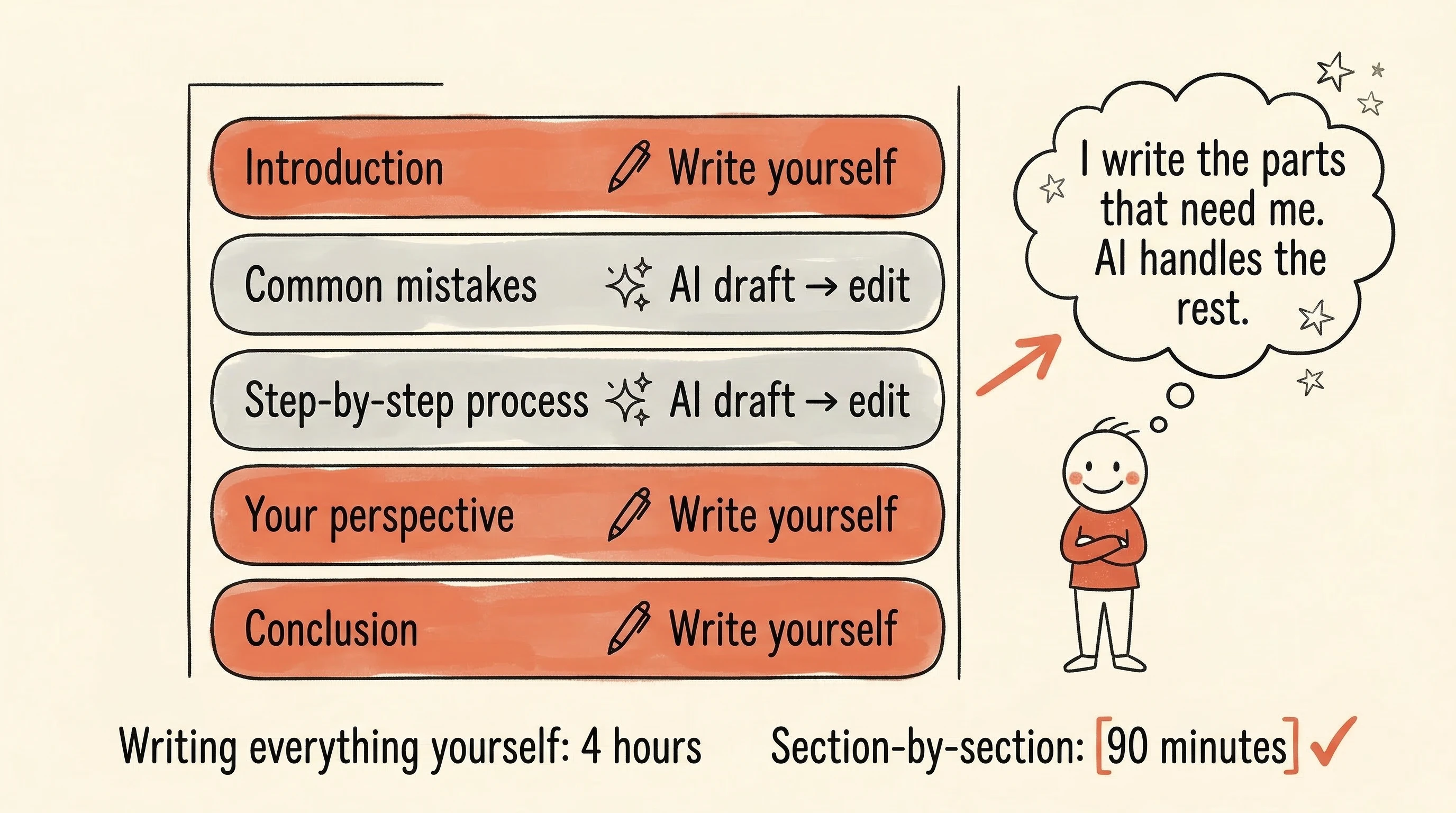
Here's what works instead: don't write the whole article yourself, and don't generate the whole article with AI. Split the difference at the section level.
Look at your outline. Some sections need your voice — the introduction where you set the tone, the section where you share your opinion or a story from your practice, the conclusion where you bring it home. Write those yourself. They're the parts your readers connect with.
Other sections are more structural. The "common mistakes" list. The step-by-step process. The "what to look for" breakdown. These sections are useful, but they don't need your personal touch the same way. Let AI generate a first draft of these sections based on your outline, then edit them to match your tone.
The result: you spend your limited writing time on the sections that actually need you, and the rest gets handled faster. The whole article still sounds like you because you wrote the parts that carry your personality, and you edited the parts that didn't.
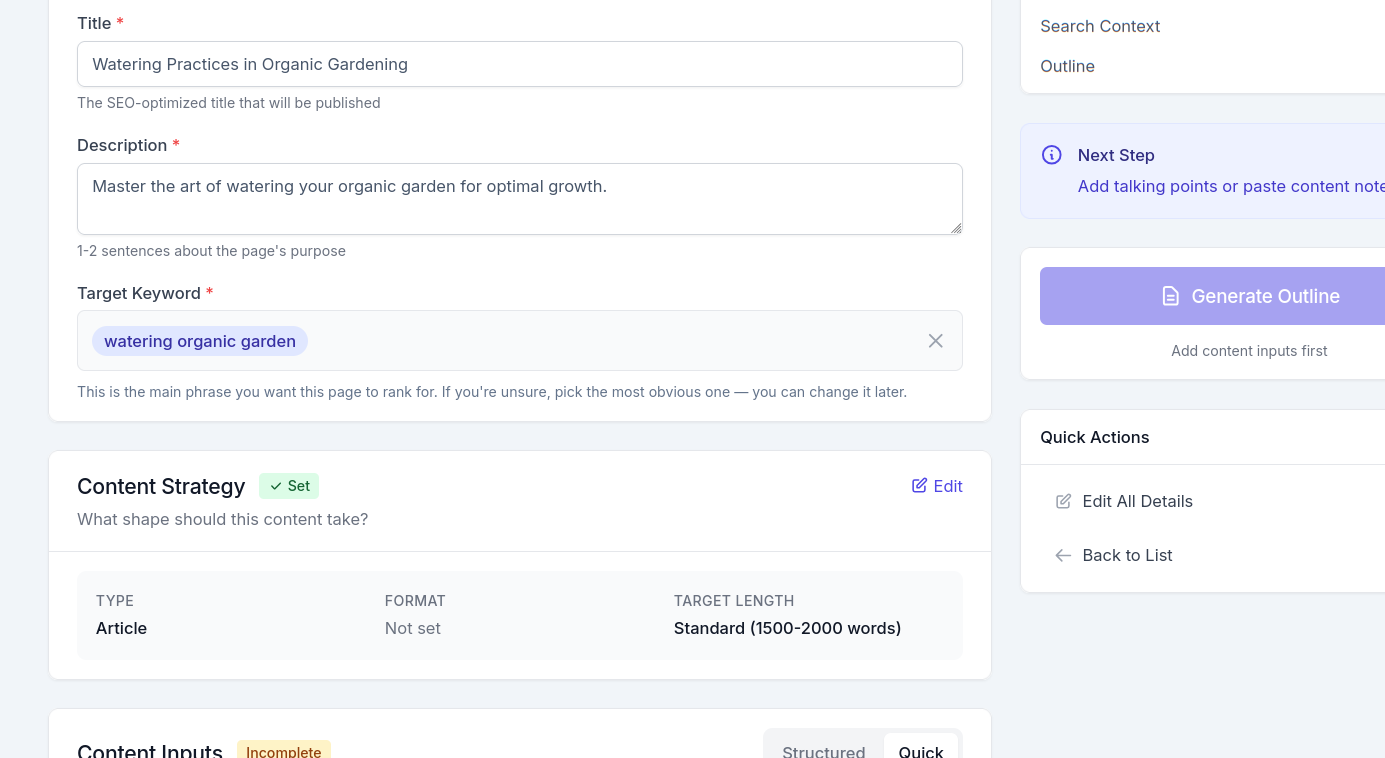
This is exactly how SitePerfector's article editor works. Each section of your outline becomes its own writing block. For each one, you choose: write it yourself, generate with AI, or start with AI and then edit. You can change your mind on any section at any point. The structure comes from your outline, and the voice stays yours.
What this looks like in practice
Imagine you're a business coach writing an article about setting boundaries with clients. Your outline has five sections:
- Introduction — why this topic matters
- Signs you need better boundaries
- Three boundary-setting frameworks
- How to have the conversation
- What changes when boundaries are clear
You write sections 1, 4, and 5 yourself. These are where your experience and personality matter most. You've had these conversations with clients hundreds of times — you know exactly what to say and how to say it.
Sections 2 and 3 are more informational. The signs are fairly universal. The frameworks can be explained clearly by AI if your outline includes the key points. So you generate those sections, read through them, swap out a few stiff phrases for your own words, add a client anecdote to section 2, and tighten up the transitions.
Total time: a fraction of what it would take to write the whole thing from scratch. And the post sounds like you — because the parts that needed to sound like you were written by you.
Done is better than perfect
One more thing that keeps solopreneurs from publishing: the belief that every post needs to be comprehensive, polished, and perfect.
It doesn't. A useful article that goes live this week does more for your business than a perfect article that sits in your drafts for three months. Your readers aren't grading your prose — they're looking for answers, insight, and a reason to trust you.
The section-by-section approach helps with this too. When writing feels like a smaller task (write these two sections, edit those three), the bar feels lower. Lower bar means less procrastination. Less procrastination means you actually publish.
And publishing consistently — even imperfectly — builds more authority, more trust, and more search visibility than occasional perfection ever will.
You already have the knowledge. You already have things worth saying. The only gap is a practical method for getting it published without losing your entire afternoon. Start with your outline, write the sections only you can write, let AI handle the rest, edit it until it sounds right, and hit publish.