
You already know content matters. Every coach, consultant, and service provider who's been at this for a while has figured that out. Articles bring people to your site. People on your site become leads. Leads become clients.
The problem isn't understanding that. The problem is that you had three content ideas during your morning session, one while walking the dog, and by the time you sit down at your desk with 45 free minutes, you can't remember any of them — or you remember all of them and don't know which one to start with.
So you check email instead. And another week goes by without publishing anything.

The real problem isn't ideas — it's losing them
You're not short on things to write about. You hear the same questions from clients every week. You see patterns in your industry. You read something and think, "I should write about that."
But where does that idea go? A sticky note? A voice memo? The bottom of a Google Doc that's already 47 lines long?
Ideas captured in scattered places are ideas that don't become articles. Not because they were bad ideas, but because they disappeared into the noise of a busy practice. When you finally have time to write, you're starting from zero — staring at a blank page, trying to remember what felt urgent three days ago.
The first thing a content system needs to do is catch those ideas in one place. Not organize them. Not prioritize them. Just catch them before they vanish.
Why "just use a spreadsheet" doesn't work when you're solo
You've probably tried this already. A content calendar in Google Sheets. A Trello board with columns you set up on a motivated Sunday afternoon. A Notion template someone recommended.
And it worked for about two weeks.
The issue isn't the tool — it's that generic planning tools require you to build and maintain the system yourself. You have to decide what columns to create, what statuses to use, when to move things. That's fine if you have a marketing team. When it's just you, the system itself becomes another task you're avoiding.
What you need is something that already has the structure. Stages that make sense for content — not generic "to do / in progress / done" columns that could apply to anything from grocery shopping to building a house.

What a content pipeline actually looks like when you're a team of one
Imagine opening one screen and seeing everything: ideas you've captured on the left, pieces you're actively working on in the middle, and finished articles on the right. Each piece is a card. Each card sits in a stage that tells you exactly where it is — needs an outline, ready to write, draft in progress, ready to publish.
That's what a content pipeline looks like. Not a complex project management board. A simple visual flow where you can see the state of all your content at a glance.
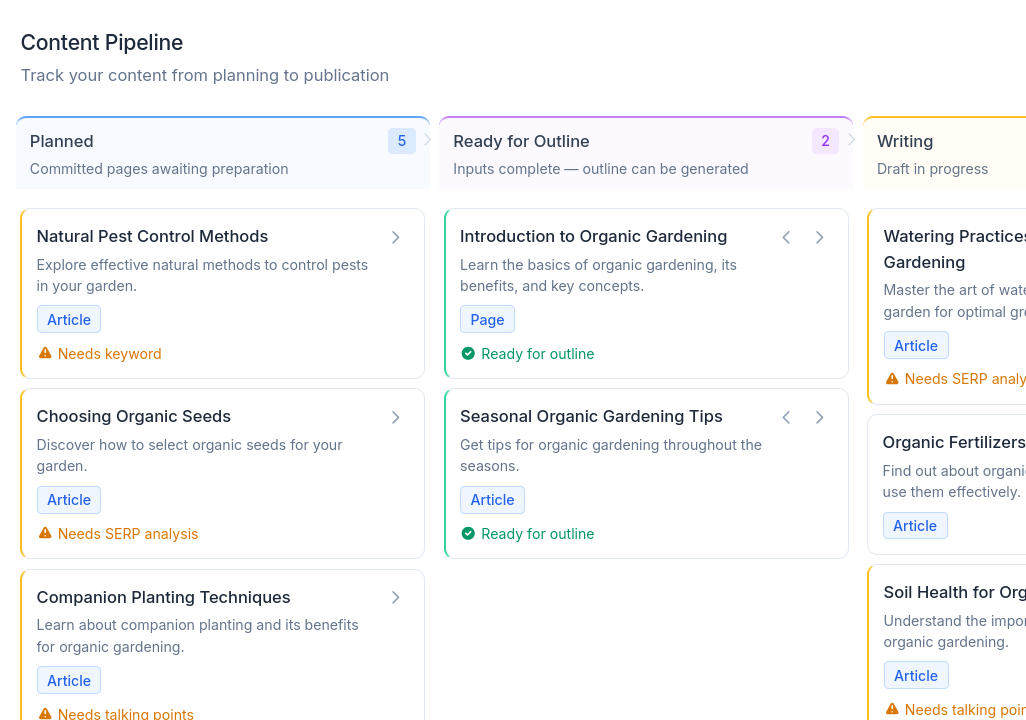
The value for a solo operator is immediate. You don't have to remember where you left off. You don't have to figure out what to work on. You open the board, find the card that's furthest along, and push it one step forward.
Some days that means brainstorming three new ideas in five minutes. Other days it means finishing a draft you started last week. The board holds the context so your brain doesn't have to.
From idea to outline to draft — without switching tools
Here's what usually happens without a connected system: you brainstorm ideas in one place, research keywords in another, outline in a Google Doc, draft in yet another tool, and publish through your CMS. By the time you're writing, you've lost half the thinking that went into picking the topic.
When idea generation, outlining, and writing all live in one flow, something changes. You generate ideas based on what people actually search for — real queries, real demand — and those ideas already have context attached. When you promote an idea to a planned page, the keyword and intent travel with it. When you start outlining, you're building on a foundation, not starting over.
This isn't about the tool being "all-in-one" as a feature checkbox. It's about your train of thought surviving from idea to published article. For someone fitting content between client calls, that continuity is the difference between publishing and not publishing.
Fitting content into a packed schedule
You don't need a "content day." That's advice for people with marketing teams and editorial calendars.
What you need is the ability to make progress in 20-minute windows. And that's only possible when the next action is obvious.
A pipeline makes the next action obvious. You open it, see a card in "needs outline," and spend 15 minutes sketching sections. Tomorrow, you see that same card now says "ready to write," and you bang out the first two paragraphs. Next time you sit down, you finish the draft.
Each session is small. But the pipeline holds the shape of your work between sessions. Progress accumulates visually — you can see cards moving right across the board, even if each work session is short.
That steady, visible movement is what turns sporadic content creation into consistent publishing. Not discipline. Not "content batching hacks." Just a system that makes small progress feel real.
Your content doesn't need to be perfect — it needs to be findable
You're never going to have as much time for content as a full-time blogger or a company with a marketing department. That's okay. You don't need to be.
What you need is a handful of well-targeted articles that answer the questions your potential clients are already asking. Written in your voice, grounded in your expertise, and published consistently enough that search engines notice.
A content pipeline won't create more hours in your day. But it will make the hours you do spend on content actually count — by making sure nothing gets lost, every session has a clear next step, and finished work makes it out the door instead of sitting in drafts forever.
The gap between "I should really be publishing content" and actually doing it isn't about willpower. It's about having a system that works at the speed of a busy practice.