
You're not short on expertise. You coach clients, run workshops, build programs — you know your subject inside and out. And somewhere on your to-do list, probably near the bottom, is "write that blog post."
The topic is clear. You might even have a keyword in mind. But the moment you sit down to write, you hit the real problem: what should this post actually look like?
What sections should it have? What order? How deep should you go on each point? Should you start with the problem or the solution? Include examples or keep it high-level?
This is the outlining step. And for most solopreneurs, it's where content goes to die.

Why outlining is where your content stalls
It's not the writing that takes forever — it's the planning before the writing.
You open a blank document. You type a working title. Then you stare at it. You might jot down a few bullet points. Then you wonder if those are the right bullet points. So you open Google, look at what other people wrote about the topic, read three competing posts, realize yours needs to be different but aren't sure how, and suddenly an hour is gone and you haven't written a single paragraph.
This is the hidden time sink. The actual writing — once you know what to say and in what order — is the part you're good at. You explain things to clients all day. Putting that into paragraphs isn't the problem.
The problem is the structural planning that comes before it. Figuring out what to cover, what to skip, and how to organize it so the post actually makes sense to someone finding it through search.
Most solopreneurs don't abandon content because they can't write. They abandon it because the planning step takes as long as the writing step, and they don't have time for both.

The problem with "just winging it"
The natural shortcut is to skip the outline entirely. Just start writing and see where it goes.
Sometimes that works. But more often, it produces posts that wander. You cover something in the introduction that should have been its own section. You miss a subtopic that your readers are specifically searching for. You write 1,500 words and realize the structure doesn't flow, but restructuring now means rewriting half of it.
The bigger issue is relevance. When someone searches for your topic, Google already has a sense of what a good answer looks like — what subtopics it should cover, what questions it should answer, what depth is appropriate. A post that misses those expectations doesn't just read poorly — it performs poorly in search.
This isn't about gaming an algorithm. It's about covering your topic thoroughly enough that it actually helps the person who searched for it. And that requires some structural planning, even if it's quick.
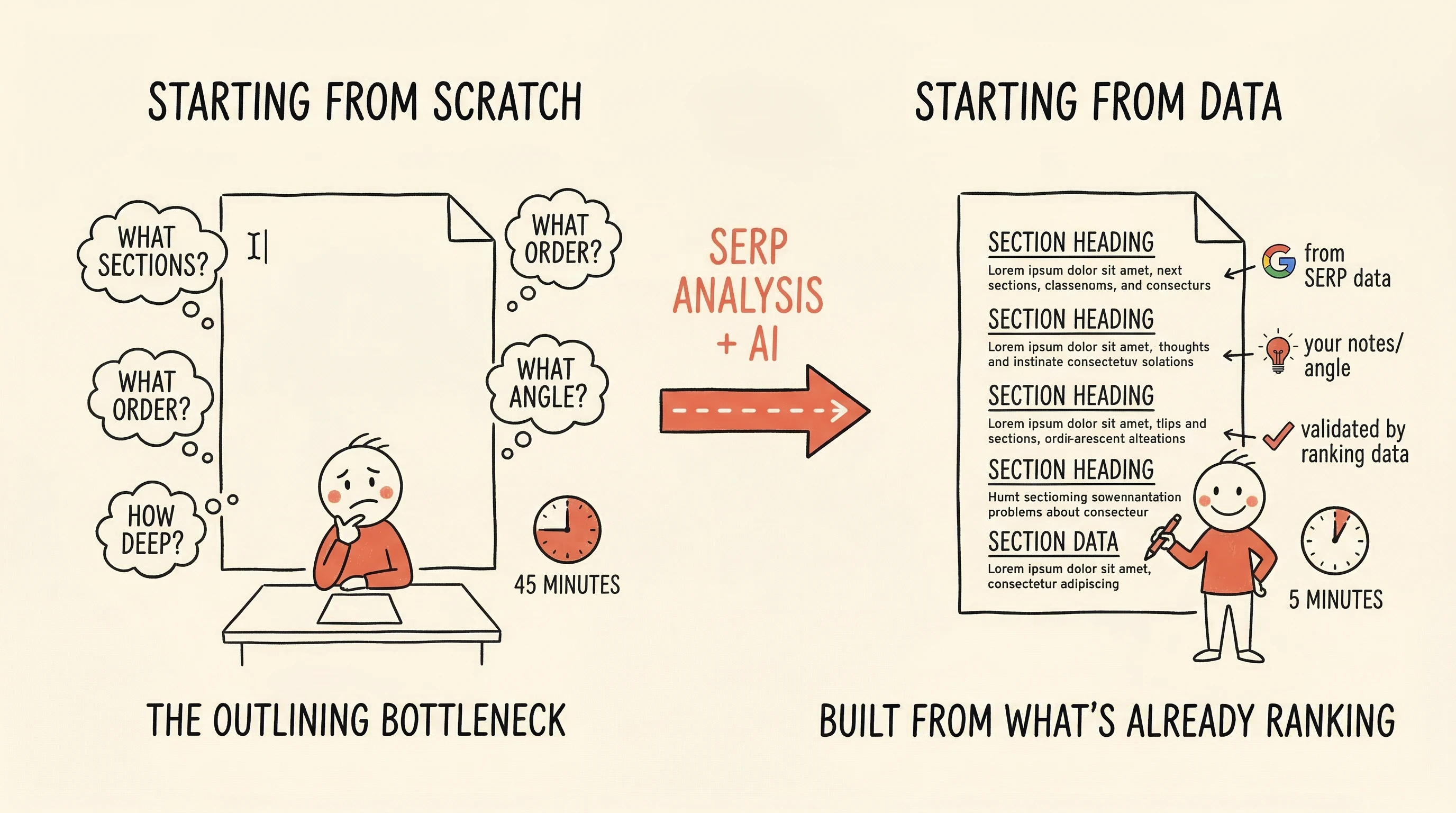
What if the outline was already done for you?
Here's the shift that changes the math on content creation: you don't have to figure out the structure yourself.
Instead of guessing what sections to include, you can start from an outline built from what's already working. The approach is straightforward — analyze the pages that currently rank well for your topic, extract the structural patterns they share, and use that as the foundation for your outline.
This is what SitePerfector's AI outline generation does. You enter your topic and keyword, choose the type of content you want (a guide, a list post, a how-to), add any notes or angles you want included, and get back a structured outline grounded in real search data.
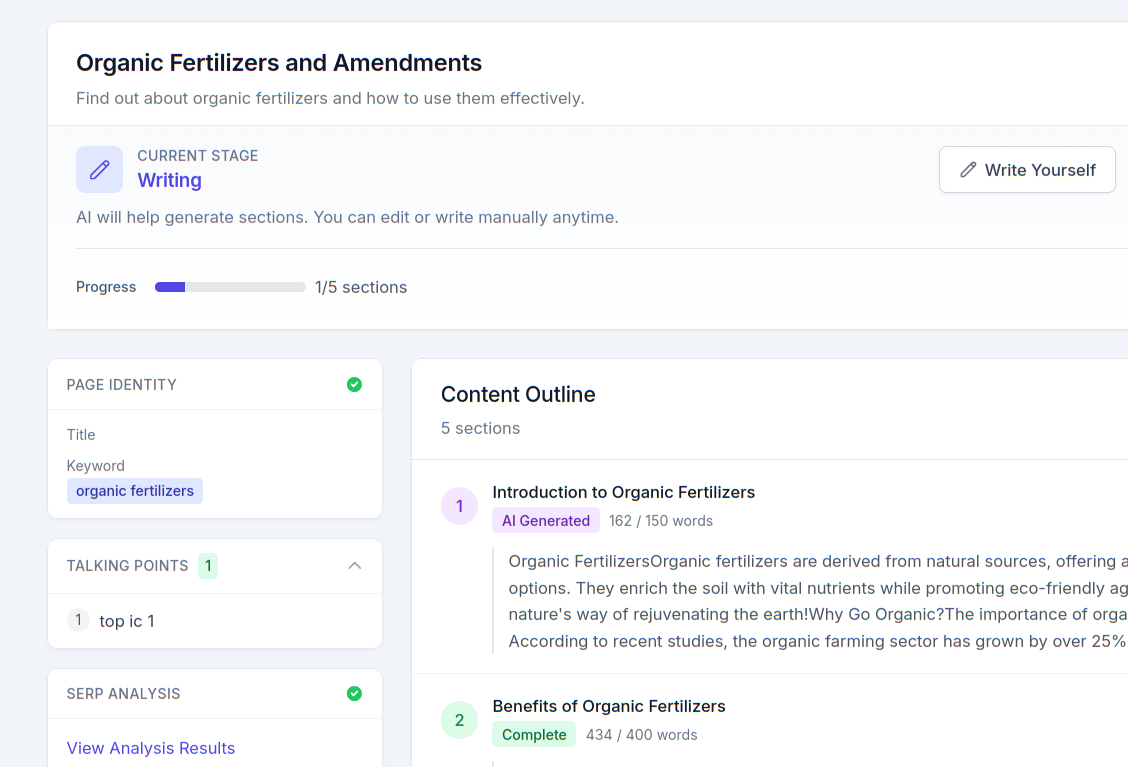
The key difference from a generic AI outline: the sections aren't invented from scratch. They're informed by what Google is already rewarding for your specific topic. If every top-ranking post about "how to price coaching packages" includes a section on tiered pricing, your outline will reflect that — because that's what searchers are looking for.
You're not copying anyone's content. You're starting with a structural foundation that's been validated by actual search results instead of guessed at from a blank page.
Adding your expertise to a proven structure
A good outline handles the "what to cover" question. You handle the "what to say" question.
This is where your expertise becomes the differentiator. The outline might include a section on common mistakes in your niche. But only you know the specific mistake your clients make every single time — the one you've corrected a hundred times in coaching sessions. That story, that insight, that practical detail is what makes the post worth reading.
The outline gives you the sections. You fill them with:
- The real questions your clients ask you
- The examples from your actual work
- The perspective that comes from years of doing this
An outline that says "Section: How to set realistic goals for [topic]" becomes something entirely different when you write it from your experience versus when a generic AI fills it in. The structure is the starting point. Your knowledge is what makes it valuable.
Edit the outline freely — reorder sections if your experience tells you a different flow works better, cut sections that don't apply to your audience, add sections the data didn't catch. The outline is a foundation, not a constraint.
From outline to published post: the fastest path
Here's what the practical workflow looks like:
Start with your topic and keyword. If you already have one from your content plan, use it. If not, enter one fresh.
Set your parameters. Pick the content type — guide, how-to, listicle, comparison. Choose a target length. Add any notes: specific points you want to cover, a client question that inspired the post, research you've already done.
Generate the outline. The system analyzes what's ranking for your topic and builds a structured outline from it, incorporating your notes.
Customize. Review the sections. Reorder, edit, remove, or add based on your expertise.
Write — your way. This is where SitePerfector gives you options. Write each section yourself using the outline as your roadmap. Use AI to draft sections that you then review and rewrite in your voice. Or mix both — write the sections where your expertise matters most, let AI handle the more straightforward ones, and edit everything to sound like you.
If you'd rather hand the whole thing off, the outline doubles as a content brief you can send to a freelance writer.
The point isn't that any single step is revolutionary. It's that the step that used to take the longest — the structural planning — is now the fastest part. And that changes whether content actually gets published or stays on your to-do list.
Content shouldn't cost you an afternoon
You didn't start a coaching or consulting business to become a content strategist. You started it because you're good at what you do and you want to help more people find you.
Content is how they find you. But the planning bottleneck — figuring out what to write, how to structure it, what to include — shouldn't take longer than the writing itself.
When the outline is handled, you're left with the part you're already good at: sharing what you know.