
If you've been blogging for any amount of time, you've developed a way of writing that's distinctly yours. Maybe it's dry humor. Maybe it's the way you break down complicated things into simple analogies. Maybe it's a directness that your readers tell you they appreciate. Whatever it is, that voice is what keeps people coming back.
So when someone suggests you "use AI to speed up your writing," there's a knot in your stomach. You've read AI-generated blog posts. They're competent and lifeless. Correct and forgettable. They read like someone fed a prompt into a machine and published whatever came out — because that's exactly what happened.
The fear that AI will flatten your writing into the same generic paste as everyone else's content is not paranoia. It's pattern recognition. But there's a way to use AI that doesn't require you to sacrifice what makes your writing yours.

The sameness problem is real
Read five AI-generated blog posts on the same topic and you'll notice they sound almost identical. Same structure. Same transitional phrases. Same slightly-too-enthusiastic tone. Same tendency to explain things that don't need explaining and gloss over things that do.
For a blogger building an audience, this sameness is poison. Your readers subscribe because of your perspective, not because you covered a topic. If your posts start reading like everyone else's, you've lost the only competitive advantage an independent blogger has.

This is why the "just generate it with AI" approach doesn't work for people who care about their writing. The speed gain isn't worth it if the output erases the thing that makes you worth reading.
AI as scaffolding, not authorship
Here's the reframe that makes AI useful without making it dangerous: AI doesn't have to write your article. It can write the scaffolding.
Every blog post has sections that carry your personality and sections that carry information. Your introduction, your opinions, your personal stories, your hot takes, your conclusions — those are you. They're the reason someone reads your version of a topic instead of the ten other versions on the internet.
But the explainer paragraphs? The "here are the common approaches" sections? The step-by-step walkthroughs? The background context? These are important for the reader, but they don't need to be written in your voice from scratch. They need to be accurate, clear, and well-structured. AI can draft those. You can edit them.
Think of it like working with a research assistant who writes rough drafts of the informational sections. You still review everything. You still rewrite anything that sounds off. But you didn't have to start from zero on the parts that are more about coverage than personality.
Where to write yourself and where to let AI draft
A practical rule of thumb:
Always write yourself: Your introduction. Any section where you share a personal experience or opinion. Your conclusion or final takeaway. Anywhere you're being funny, contrarian, vulnerable, or specific about your own journey.
Good candidates for AI drafts: Background explanations. Lists of common methods or approaches. Step-by-step instructions. Definitions or comparisons. Sections that synthesize widely-known information.
The key is that you decide section by section. Not the whole article — just each part. Some posts might be 80% you and 20% AI-drafted. Others might be 50/50. It depends on the topic and how much of it requires your specific take versus general knowledge.
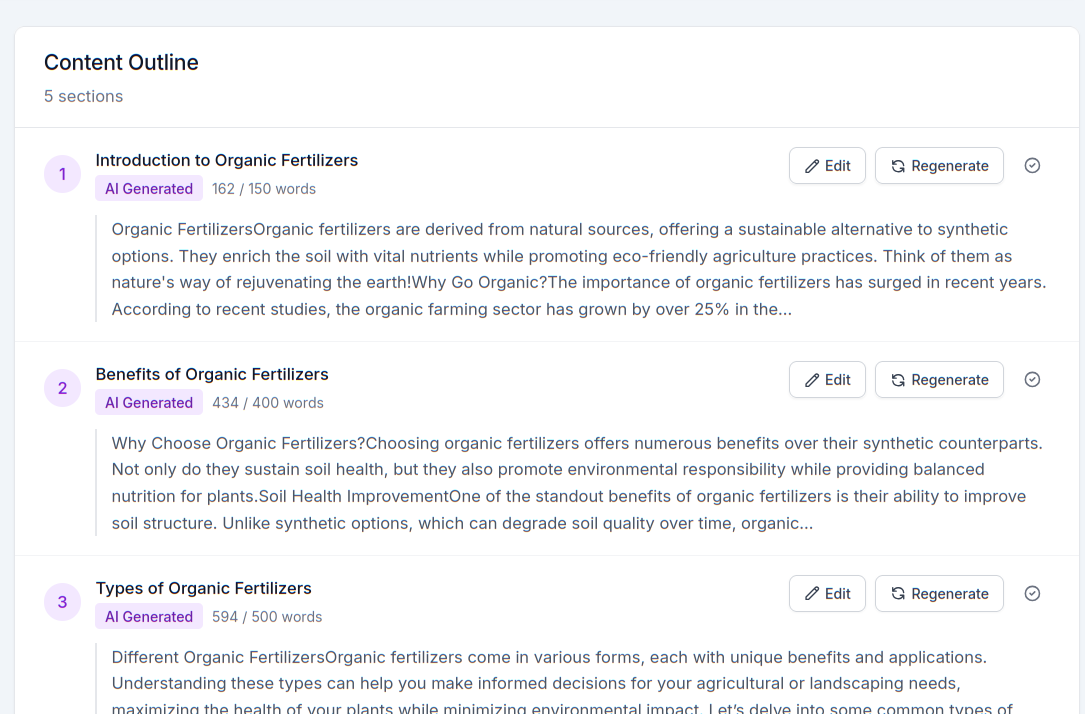
SitePerfector's article editor is built around exactly this workflow. Each section of your outline is its own block, and you pick the approach for each one — write it yourself, generate with AI, or start with AI and rewrite. The AI drafts follow the structure of your outline, which is itself built from what real people are searching for, so the generated content stays on-topic rather than drifting into filler.
The editing pass that makes it yours
Here's the step most people skip, and it's the one that makes the whole approach work: editing the AI-generated sections until they sound like you.
This isn't a full rewrite. It's a targeted pass where you:
- Replace stiff or formal phrasing with how you'd actually say it
- Cut sentences that sound like padding (AI loves to restate things it just said)
- Add a short aside, joke, or observation where the text feels too sterile
- Fix transitions that feel robotic (AI is particularly bad at natural-sounding transitions between sections)
- Remove any qualifiers or hedging that don't match your style
This pass usually changes 20-30% of the AI-generated text. The structure stays. The information stays. But the voice becomes yours. It's faster than writing from scratch, and the result is indistinguishable from something you wrote entirely by hand — because the parts that matter were written by you, and the rest got your editorial fingerprints.
More output without lower quality
The tension every blogger feels: you want to publish more often because consistency matters for growing an audience and building search traffic. But you don't want to publish worse content because that erodes trust and makes you feel like a fraud.
The section-by-section approach resolves this. You're not lowering your quality standard — you're being strategic about where your time goes. The sections that define your quality (voice, perspective, originality) still get your full attention. The sections that support your quality (explanations, context, structured information) get drafted faster.
The net effect: you publish more frequently without the drop in quality you were afraid of. Your readers still get your voice, your personality, and your insights. They also get thorough, well-structured posts — because the AI-assisted sections aren't lazy shortcuts, they're efficient first drafts that you refined.
You don't have to choose between your voice and your publishing schedule. You just need a smarter way to divide the work.