
You have a notes app full of post ideas. A spreadsheet of keywords you want to target. Maybe a content calendar with dates that quietly passed weeks ago.
The ideas aren't the problem. The writing isn't the problem either — you enjoy that part. The problem is everything between "great topic idea" and "structured post ready to write."
That gap — where you research what's already out there, decide what sections to include, figure out what order to put them in, and try to cover the topic thoroughly enough that Google cares — eats entire afternoons. And it's the reason most of those post ideas are still sitting in your notes app.

The outlining trap bloggers fall into
Here's the pattern. You sit down to write a post about a topic you know well. You type the title. You write an opening paragraph. Then you pause.
What comes next? Should you define the concept first, or jump into the practical steps? Should you include a section comparing approaches, or is that a separate post? How deep should you go? What are other bloggers covering that you might be missing?
So you open a few competing posts. You read them. Now you're second-guessing your angle. Their structure is different from what you had in mind. Maybe you should reorganize. Maybe you need more research.
Two hours later, you have half an outline, three open tabs you forgot about, and the sinking feeling that you should just "come back to this one tomorrow."
This is the outlining trap. It's not writer's block — you can write just fine once you know the structure. It's planner's block. The structural decisions before the writing are where your content stalls.
Why generic outlines produce generic content
The obvious solution is to let AI generate your outline. And plenty of tools will do that — you type a topic and get back a list of sections.
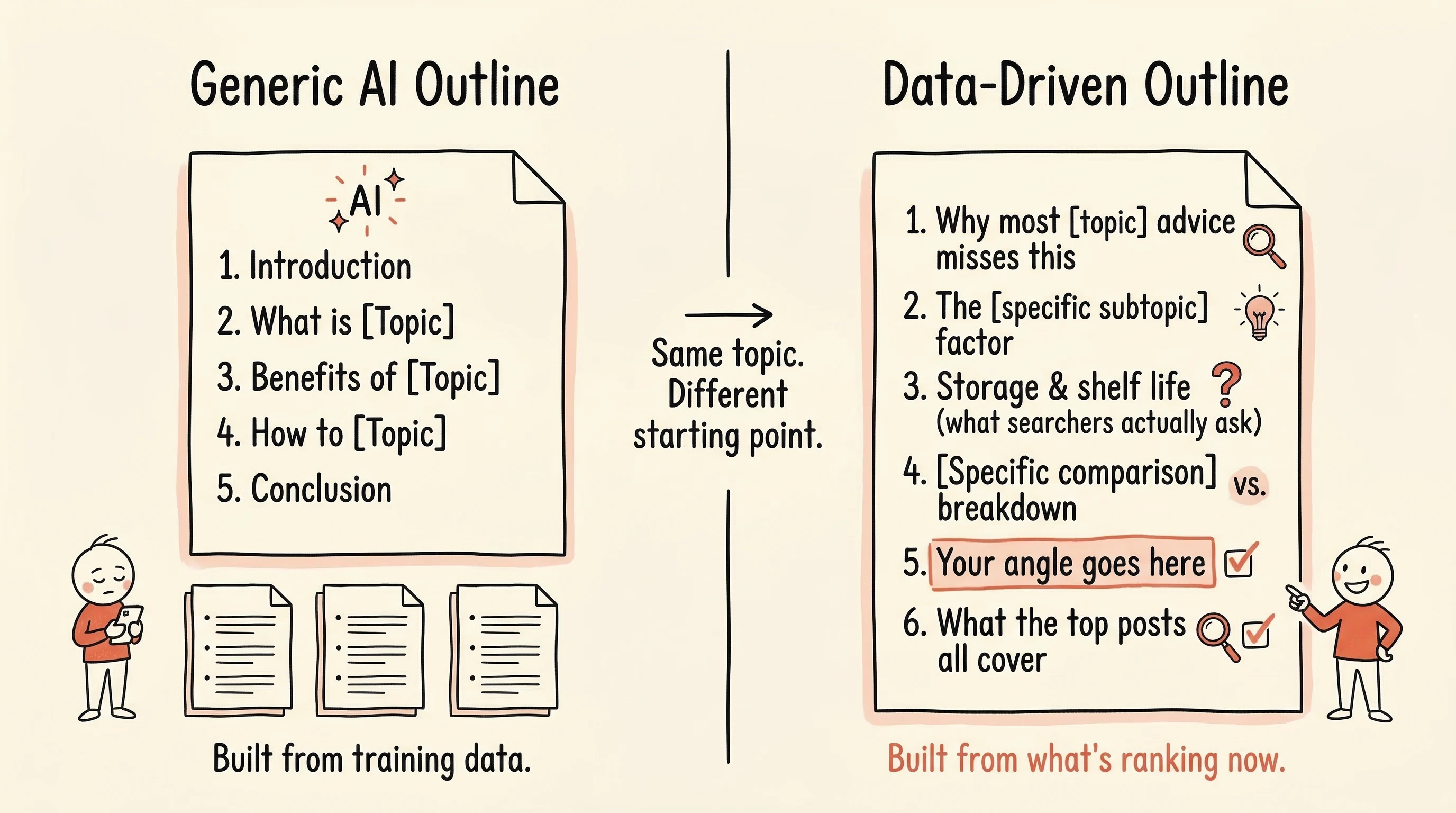
But here's what happens with most AI-generated outlines: they're built from the AI's training data, not from what's currently relevant for your specific topic. The AI knows what blog posts generally look like. It doesn't know what's actually ranking right now, what questions searchers are specifically asking, or what structural patterns Google is rewarding for your keyword.
The result is a safe, generic structure. "Introduction. What is [topic]. Benefits of [topic]. How to [topic]. Common mistakes. Conclusion." You've seen this skeleton a thousand times. So has everyone else.
That's the real voice killer — not the AI itself, but the undifferentiated structure underneath. If your outline looks like every other outline, your finished post will feel like every other post, no matter how good your writing is. Structure shapes content more than most bloggers realize.

What changes when your outline is built from real search data
There's a different approach to outline generation, and the difference matters.
Instead of generating structure from generic patterns, SitePerfector analyzes the pages that currently rank well for your specific topic. It looks at what sections those posts include, what questions they answer, what subtopics they cover, and what structural patterns they share. Then it builds your outline from that real landscape — incorporating your notes, your angle, and your chosen format.
This isn't copying what competitors wrote. It's understanding what the search landscape expects for your topic so your post doesn't have blind spots.
Say you're writing about meal prepping for busy people. A generic AI outline gives you the same five sections every meal prep post has. An outline built from search data might reveal that top-ranking posts all include a section on storage containers and shelf life — something you wouldn't have thought to include but searchers clearly want answered.
Your outline covers what matters. Your writing makes it yours.
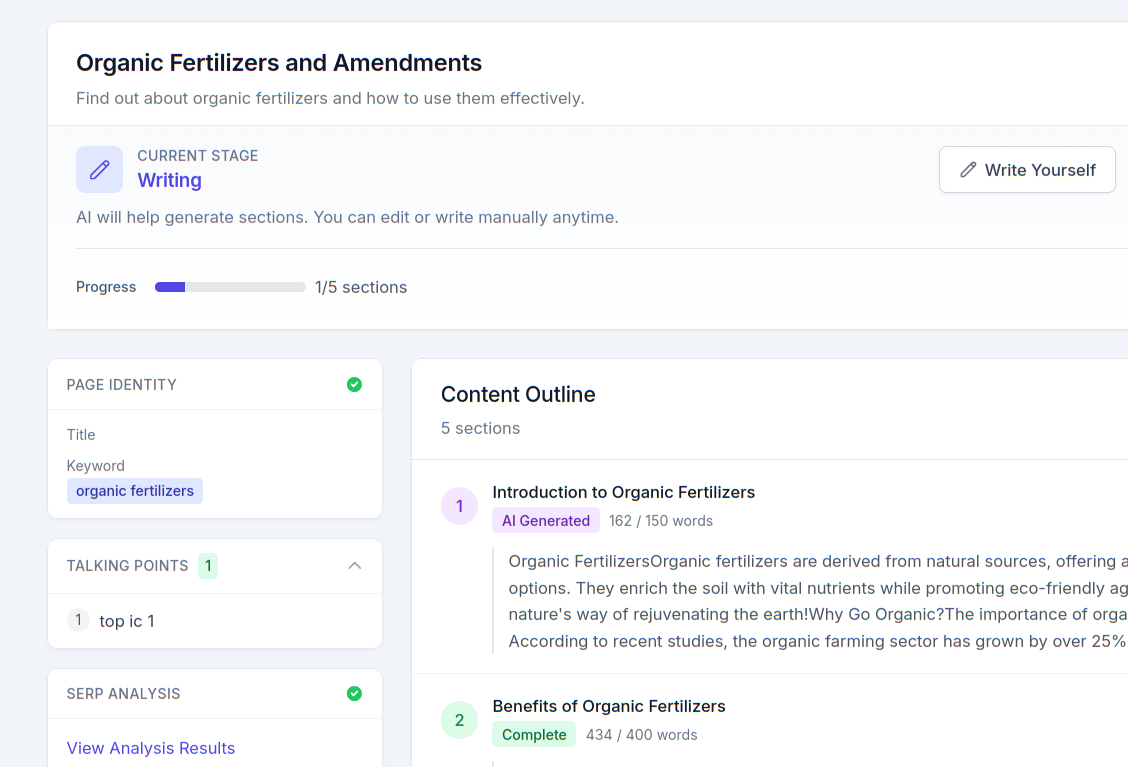
The practical steps are simple: you choose your topic and keyword, pick the content format (guide, listicle, how-to, comparison), set a target length, and add any notes — your angle, specific points you want to hit, research you've already done. The system handles the structural analysis and gives you back a ready-to-write outline.
The outline is the skeleton — your writing is the muscle
Here's the part that matters most if you care about your voice: the outline is purely structural. It tells you what to cover and in what order. It says nothing about how to cover it.
A section heading like "Why most meal prep advice fails for single people" is a container. What goes inside — your tone, your humor, your personal experience, the specific examples you choose — is entirely yours.
This is where the process gets practical. Once you have the outline:
Reorder sections if your instinct says a different flow works better. You know your audience's reading patterns. If you think the "common mistakes" section works better near the top as a hook, move it.
Cut sections that don't fit your angle. The outline might include a section on a subtopic that doesn't match what you want to say. Remove it. The outline is a starting point, not a mandate.
Add sections the data didn't catch. Maybe you have a unique perspective — a personal story, a contrarian take, a niche tip — that doesn't show up in top-ranking posts because nobody else has your experience. Add it. That's your differentiation.
Write each section your way. You can write every section yourself, using the outline as a roadmap. You can let AI draft certain sections and then rewrite them in your voice. You can mix both — write the personal sections yourself and let AI handle the more informational ones that just need to be solid. SitePerfector gives you that flexibility per section, not as an all-or-nothing choice.
The outline handles the structural thinking — what to cover, what order, what depth. You handle the creative work — how it sounds, what it says, why anyone should care. Those are fundamentally different jobs, and separating them makes both easier.
Publishing consistently starts with faster planning
Every blogger knows the gap between "I should publish weekly" and actually publishing weekly. And the bottleneck is almost never the writing itself.
It's the planning before the writing. The research. The structuring. The second-guessing about whether you're covering the right subtopics. That planning overhead turns what should be a writing session into a research project, and it's why publishing schedules slip.
When the structural planning is handled — when you sit down and the outline is already there, ready to write from — your creative energy goes entirely into the writing. One post becomes a writing session, not a planning-then-writing session.
This doesn't mean rushing. It means spending your limited time on the part you're good at and the part that actually makes your content different: the writing. Not the structural research. Not the "what should I include?" paralysis. Not the competitor-post rabbit hole.
Consistent publishing comes from a shorter distance between "I want to write this" and "I'm writing this." Removing the outlining bottleneck is the highest-leverage way to close that gap.
Your readers follow you for your perspective
The people who subscribe to your blog, share your posts, and come back for more — they're not there for your SEO skills. They're there because of how you think, how you explain things, and the unique angle you bring to your niche.
The outline handles the structure so your posts cover what searchers need. You handle the voice so your posts are worth reading. That's the split.
Your writing is the part that can't be automated. Start from a structure that's already validated, and put your energy where it matters most.