
You have a notes app full of article ideas. A Google Doc titled "Blog Topics" that's three pages long. Maybe a Notion board with columns you set up once and haven't touched since.
You don't lack ideas. You lack a system that turns them into published posts.
And that gap — between "I have tons of ideas" and "I published something this week" — is where most content creators get stuck. Not because they're lazy or unmotivated. Because having too many unstructured ideas creates its own kind of paralysis.

You don't have a creativity problem — you have a finishing problem
Think about the last five content ideas you had. How many became published articles?
If you're being honest, probably one. Maybe none.
The ideas themselves were fine. The breakdown happened somewhere between "that's a good topic" and "that's a published post." Maybe you couldn't decide which to start. Maybe you started three and finished none. Maybe you got to the outline stage and realized you didn't have a clear angle, so you moved on to the next idea that felt more exciting.
This is the finishing problem. And it doesn't get better by having more ideas. It gets worse. Every new idea added to a shapeless list makes the list harder to act on.
What's missing isn't inspiration. It's a structure that moves ideas forward in stages — so they stop being a pile and start being a process.
Why most content planning systems fail creators
You've tried to solve this before. A Trello board with columns. A Notion content calendar. A spreadsheet with dates and topics and color-coded status cells.
These tools share the same problem: they're blank canvases. They give you empty columns and expect you to design a workflow that makes sense for content creation. That design work — deciding on stages, defining what "ready" means, figuring out how ideas flow into drafts — is exactly the kind of meta-work that feels productive but isn't actually writing.
So you spend an afternoon building the system, feel good about it, and then never open it again. Because the system was the project, not the content.
A content planning tool should come with the structure already built. Stages that make sense for how content actually gets made — not generic task management columns you have to repurpose.
The difference between collecting ideas and curating them
There's a moment in every creator's workflow that most tools ignore: the decision.
Capturing ideas is easy. You write them down, you dump them somewhere, done. But deciding which ideas are worth writing — that's where things stall.
When all your ideas live in one flat list with equal weight, every idea feels equally possible and equally distant. You can't tell the good ones from the half-baked ones. So you either pick randomly (and lose motivation halfway through) or don't pick at all.
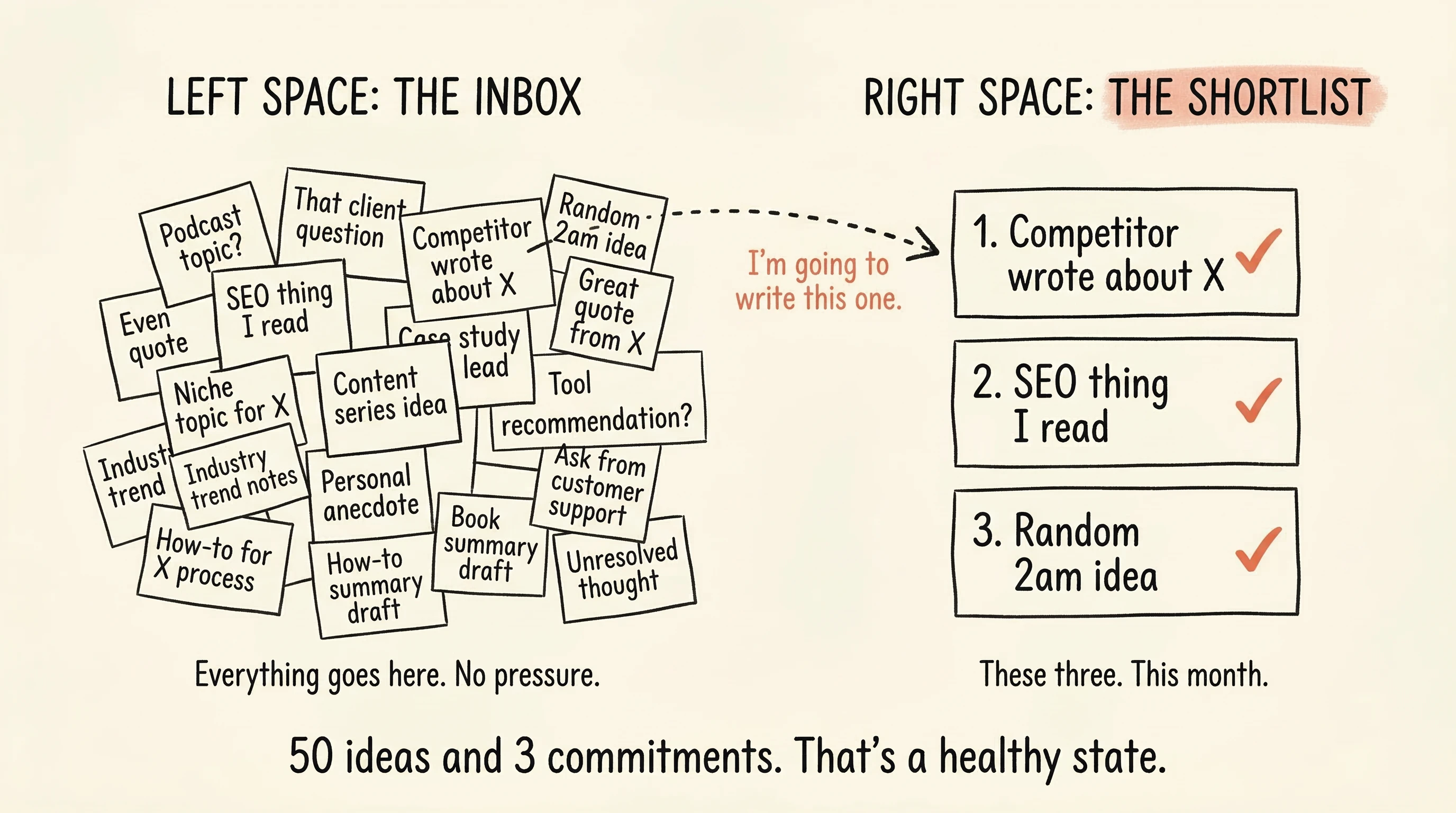
This is why separating brainstorming from curation matters. You need two spaces: one where everything goes without pressure — a thinking space, almost like a notebook — and one where you've actively said, "Yes, I want to write this."
That simple split changes the psychology. You go from "I have 50 ideas and I'm overwhelmed" to "I have 50 ideas in the inbox and 3 I've chosen to pursue." The inbox can be messy. The shortlist is intentional. That's enough structure to start moving.

Seeing your content as a flow, not a list
Lists are static. You add to the bottom, scan from the top, and nothing ever moves. A piece of content that's been on your list for a month looks the same as one you added yesterday.
A visual pipeline changes that. When your ideas, outlines, drafts, and finished pieces live on a content pipeline board, you see your content as a flow. Things move from left to right. You can see what's stuck, what's progressing, and what's almost done.
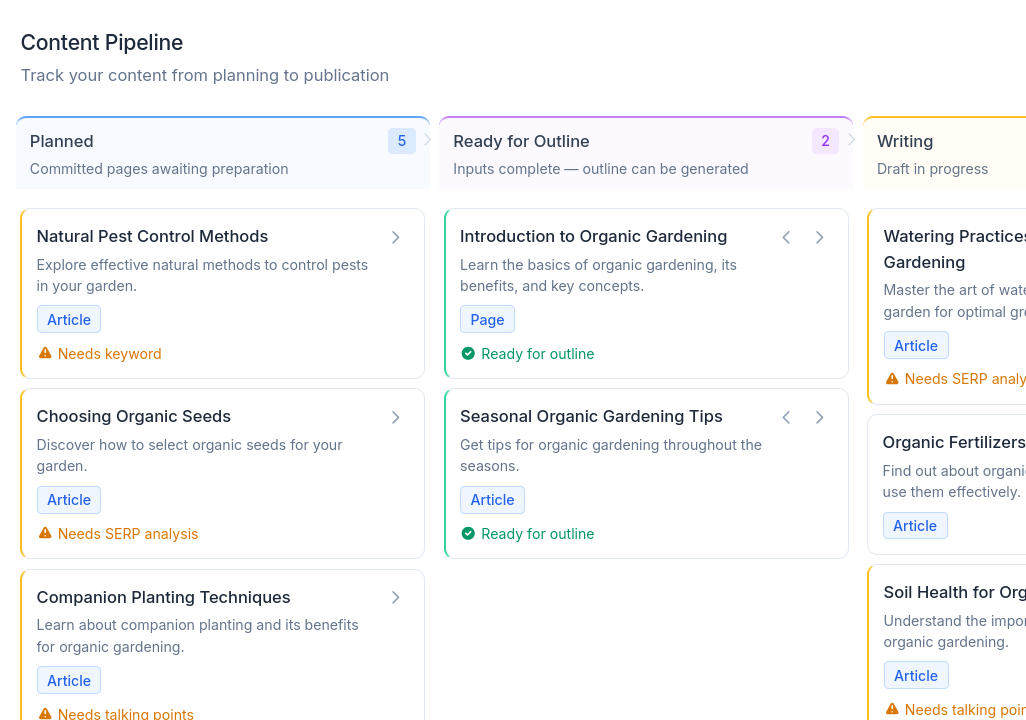
This matters more than it sounds. When you open a board and see three cards in "draft in progress," your brain doesn't ask "what should I work on?" It asks "which of these am I closest to finishing?" That's a much easier question to answer. And it leads to published work instead of endless starting.
The board also makes stalled content visible. That post you started two weeks ago and forgot about? It's sitting in the outline column, waiting. Not lost in a notes app. Not buried in a doc. Right there, where you can see it and decide: finish it or kill it.
Ideas from real search demand, not staring at a blank page
Here's something that changes the "what should I write about?" problem entirely: starting with what people are already searching for.
Instead of brainstorming in a vacuum and hoping someone cares about your topic, you can generate ideas based on real search queries — actual things people type into Google in your niche. Keywords matched to your site, grounded in real demand.
This does two things. First, it solves idea drought. You're not staring at a blank page wondering what to write. You're looking at a list of topics people are already looking for and picking the ones that fit.
Second, it removes the "will anyone read this?" anxiety. When you know the idea came from real search data, you're not guessing whether the article will bring traffic. You're writing something that has a built-in audience.
The ideas still need your voice, your angle, your expertise. The data just tells you where the demand is. You bring everything else.
Publishing consistently without burning out
Consistency doesn't mean publishing every day. Or even every week, if that's not sustainable for you.
Consistency means having a visible flow of content at different stages, so you always have something to work on regardless of your energy level. High-energy day? Write a full draft. Low-energy day? Triage some ideas, promote one to your shortlist, or edit a draft that's almost done.
The pipeline holds the shape of your work even when your motivation fluctuates. That's the difference between a system and willpower. Willpower runs out. A system with visible progress doesn't guilt you into working — it shows you the smallest possible next step and lets you decide.
Some weeks you'll publish two articles. Some weeks you'll just move a few cards. Both are progress, and both are visible on the board. That matters when you're building something long-term.
The gap is smaller than you think
The distance between "aspiring blogger" and "publishing blogger" isn't talent. It isn't discipline. It isn't finding some perfect content strategy.
It's having a system that takes your ideas — the ones you already have — and gives them a clear path from "maybe" to "done." One that separates the brainstorming from the building. One that shows you where things stand so you stop starting over every time you sit down to write.
You already have enough ideas. What you need is a pipeline that moves them forward.