
You know the cycle. You have an idea for a post. It feels right — you're interested in the topic, you have something to say about it, and you can picture your audience reading it. So you write it. You edit it. You publish it. You share it on social media.
Then you check your analytics a week later and the organic traffic line is flat. Nobody found it through search. So you write another one. Same thing.
After a few months of this, the motivation starts to drain. Not because you can't write — you can. But because publishing into silence makes you wonder whether the whole "start a blog" thing actually works.
It does work. But there's a step most blogging advice glosses over, and it's the step that separates blogs that grow from blogs that stall: knowing what people are actually searching for before you write.
The gut-feel publishing cycle
Most bloggers start the same way. You write about what interests you, what you know about, or what you saw someone else post about. There's nothing wrong with any of that — those are fine starting points for ideas. The problem is when that's your entire strategy.
A topic that fascinates you might have zero search traffic behind it. A topic that seems obvious might be so thoroughly covered by established sites that a newer blog has no realistic chance of appearing in search results.
And you'd never know either of those things unless you checked.
This is the gut-feel cycle: come up with idea, write it, publish it, hope for traffic, see nothing, repeat. It's not a content strategy — it's a content lottery. And the odds aren't great.

The fix isn't to stop writing about what interests you. It's to add one step before you write: confirm that real people are searching for this topic and that your blog has a shot at ranking for it. That single check changes everything.
Why keyword tools feel like they're not for you
You've probably tried. You Googled "keyword research tool," signed up for something, typed in a topic, and got back a screen full of numbers. Search volume. Keyword difficulty. CPC. Competition index. Trend arrows. Maybe a SERP analysis panel you didn't ask for.
You stared at it for a minute, sorted by one column, then another, felt no closer to an answer, and closed the tab.
That experience is almost universal among bloggers. And the reason is straightforward: those tools were built for SEO professionals and marketing agencies. People who know what a "keyword difficulty of 43" means and have a framework for interpreting it. People who manage keyword portfolios across dozens of client sites.
That's not you. You have one blog. You need to know: should I write about this topic or not? That's a yes-or-no question, and the tools are giving you a spreadsheet.
The issue isn't that you're bad at keyword research. The issue is that the available tools require a level of SEO literacy that most bloggers don't have — and honestly don't need.

The only two things you need to know about a keyword
Here's what all those metrics are really trying to tell you, stripped down to what matters:
Does this keyword fit your blog's topic? If you write about personal finance, "best budgeting apps" fits. "Best productivity apps" is adjacent but probably doesn't. "Best gaming laptops" definitely doesn't. Relevance isn't just about whether you could write about something — it's about whether Google will see your blog as a credible source on that specific topic.
Is this keyword a realistic opportunity for your blog? Some keywords are locked up. The first page of results is all major publications with hundreds of linking sites and years of content. Your brand-new blog post isn't going to displace them, no matter how good it is. Other keywords — especially longer, more specific ones — have weaker competition and genuinely open spots.
That's it. Fit and opportunity. If a keyword scores well on both, it's worth writing about. If it fails either one, skip it and pick the next option.
Every other metric — difficulty scores, volume ranges, CPC data, click-through estimates — is a more granular, more technical way of getting at those same two answers. And for a blogger who needs to decide what to write about this week, the granularity just creates noise.
How filtered suggestions change the game
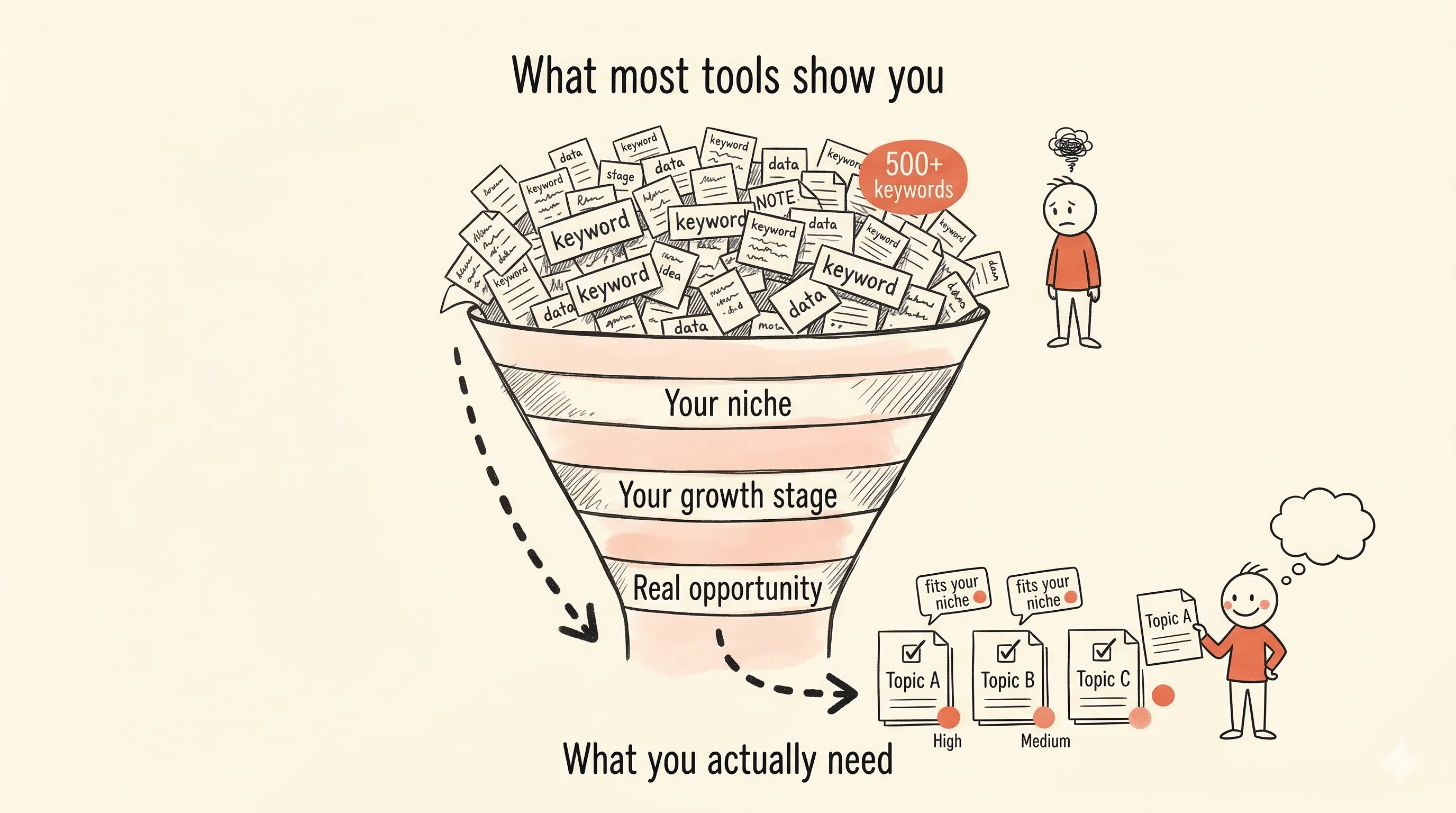
Imagine opening a tool and instead of a spreadsheet with hundreds of keywords and ten columns of numbers, you see a short list. Each keyword has already been checked against your blog's niche for relevance and against your site's current strength for realistic opportunity.
Next to each keyword, two clear signals: fits or doesn't fit your topic, and good or not good as an opportunity right now.
That's the approach SitePerfector's keyword suggestions take. You tell it about your site and your niche. It analyzes real search data, filters out everything irrelevant or unrealistic, and shows you what's left — pre-curated, already interpreted, ready to act on.
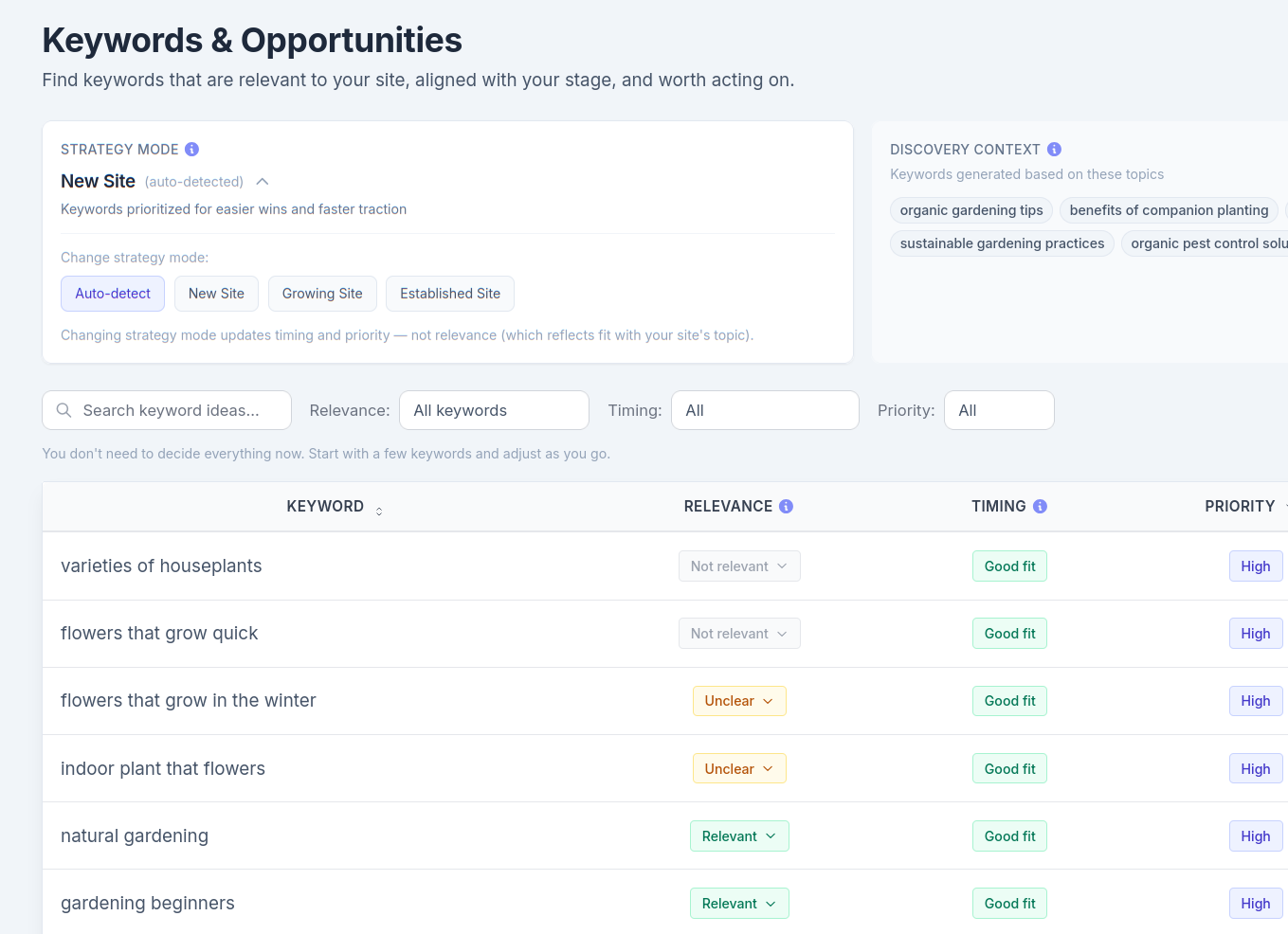
No spreadsheet to sort. No scores to decode. No second-guessing whether a difficulty of 38 is too high or a volume of 720 is too low. The tool does the interpretation and gives you the answer: this keyword fits what you write about, and your blog has a real shot at ranking for it.
For bloggers, this changes the dynamic completely. Instead of spending an hour trying to make sense of keyword data, you spend a few minutes scanning a list of suggestions that already make sense for your specific blog. The research step goes from being the part you dread to the part that gives you clarity.
And here's what matters for your voice: a keyword tool tells you what to write about. It doesn't tell you how to write it. Your perspective, your style, your way of explaining things — that's still entirely yours. The tool just points you toward topics where your writing will actually get found.
Building topic clusters instead of random posts
There's a compounding effect that most bloggers miss when they pick topics one at a time.
Say you write a post about "how to start a bullet journal." It does okay. Then you write about meal prepping. Then about morning routines. Then about budgeting tips. Four posts, four completely different topics. Google sees your blog as unfocused — a little bit about journaling, a little bit about cooking, a little bit about finance.
Now imagine a different approach. You write about "how to start a bullet journal." Then "bullet journal layouts for beginners." Then "bullet journal habit tracker ideas." Then "digital vs. paper bullet journals." Four posts, all reinforcing the same topic area. Google starts to see your blog as a go-to source for bullet journaling. Each post strengthens the others. Traffic compounds.
This is what topic clusters do, and it's where good keyword suggestions naturally lead. When a tool suggests keywords matched to your niche, the suggestions tend to group around related subtopics. Instead of a random list of unrelated ideas, you get clusters of related keywords that, written together, build your blog's visibility in a specific area.
Over time, that's the difference between a blog that starts from zero with every new post and a blog where each post makes the previous ones perform better.
What actually separates growing blogs from stuck ones
The bloggers who build real organic traffic aren't necessarily better writers. They've just closed one gap: they check whether people are searching for their topic before they invest time writing about it.
That's the whole secret. It's not about mastering SEO or spending hours in keyword tools. It's about having a way to confirm — quickly and clearly — that a topic is worth your time.
That doesn't require a spreadsheet full of metrics. It requires a tool that tells you plainly: this topic fits your blog, and it's a real opportunity. SitePerfector was built to give you exactly that — two clear signals per keyword, grounded in real search data, matched to your specific niche and growth stage.
So you can get back to the part you actually care about: writing.