
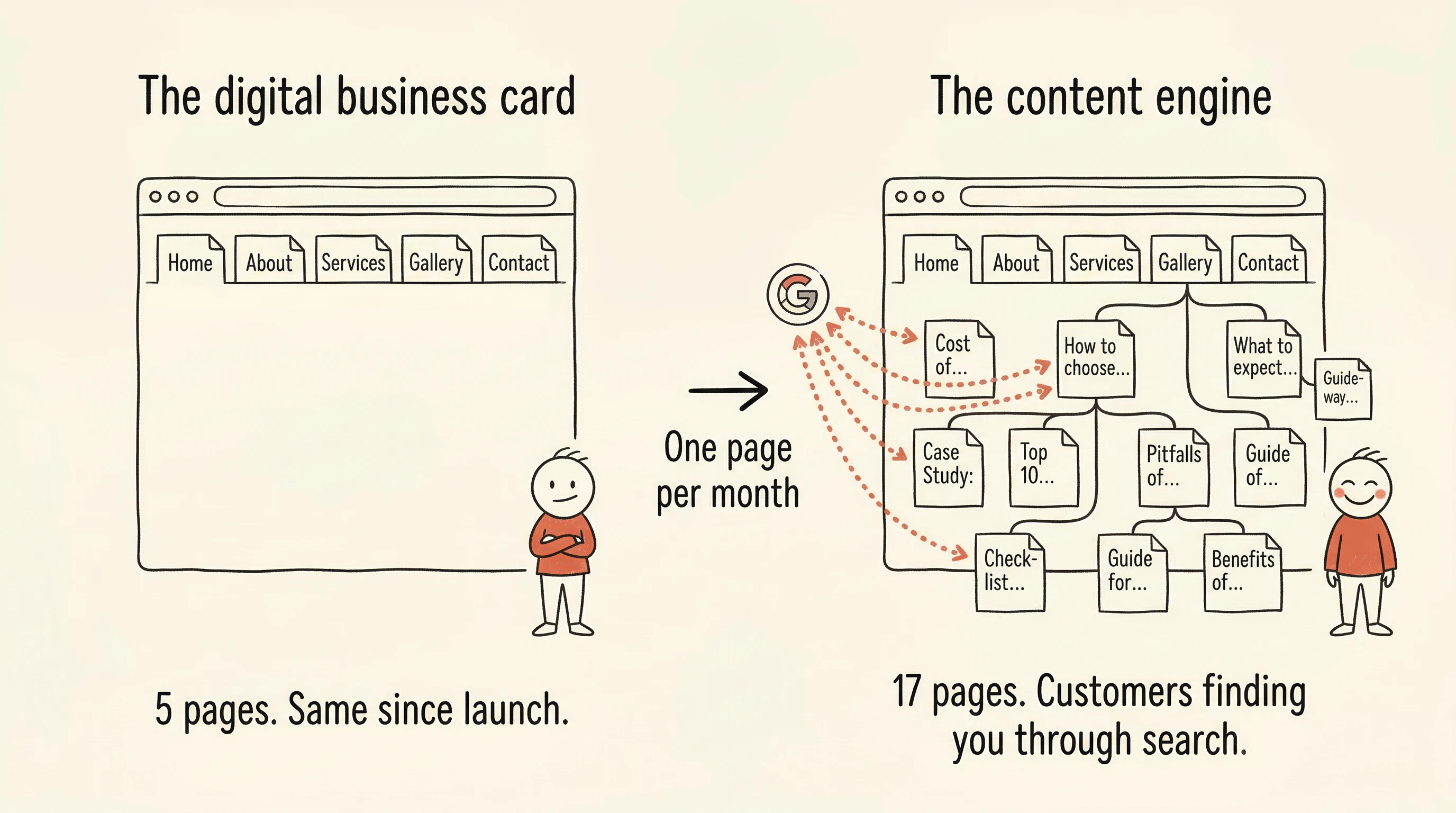
Your website has five pages. Home, About, Services, maybe a Gallery, and Contact. They've looked the same since you launched the site. Maybe you've updated your phone number once.
It works fine as a digital business card. But it's not bringing you new customers.
Meanwhile, every day, people in your area are searching for things directly related to what you do. "How much does a kitchen remodel cost." "Best time to list a house." "What to expect at a first therapy session." These are your future customers, typing real questions into Google — and landing on someone else's website because you don't have a page that answers them.
You don't need to become a blogger to fix this. You need to start putting answers on your website.

Your website can do more than sit there
Most small business websites are static. They describe what you do, list your hours, maybe show some photos. And that's fine for people who already know you exist.
But what about the people who don't know your business name? They're not searching for you — they're searching for what you do. They're typing questions, looking for services, comparing options. And Google sends them to the websites that have helpful, relevant content.
That's the gap. Your competitors who rank above you aren't necessarily better at what they do. They just have more pages on their site that answer the questions your shared customers are asking.
Adding even a handful of targeted pages — each answering one specific question your customers commonly search for — can change how many people find you.
You don't need to "blog" — you need to answer questions
The word "blog" makes most business owners tune out. It sounds like a hobby. Something influencers and lifestyle brands do. Not something a plumber or a real estate agent or a salon owner needs.
But forget the word. Think about it this way instead.
Your customers ask you the same five questions over and over. During consultations, on the phone, in emails. You answer them every time because they're genuinely useful questions.
Now imagine each of those answers lived on your website as its own page. A page titled "How Much Does a Bathroom Renovation Actually Cost?" or "What to Look for When Choosing a Family Lawyer." Written in your words, based on your real experience.
That's not blogging. That's putting your expertise where people can find it. And search engines reward exactly this kind of content — specific, helpful answers written by someone who actually knows the subject.
The problem with winging it
Without a plan, content creation for a small business looks like this: you get motivated one afternoon, write a post, publish it, and then don't think about content again for three months. Then you feel guilty, write another one, and the cycle repeats.
The result? A blog section with four posts spread across two years. No momentum, no consistency, and no real impact on your search visibility.
This isn't a discipline problem. It's a structure problem. When there's no system telling you what to write next or showing you what you've already got in progress, every content session starts from scratch. You have to re-motivate yourself, pick a topic from nothing, and push through the whole process in one sitting.
That's exhausting. And it's why most small business owners give up on content entirely.

What "content planning" looks like when it's just you
Content planning sounds like something that requires a marketing team and a monthly strategy meeting. It doesn't.
Here's what it actually looks like for a business owner working alone: you open one screen. On it, you see a visual pipeline — a simple board with columns for each stage of content. Ideas on the left. Pages you're planning in the middle. Finished pieces on the right.
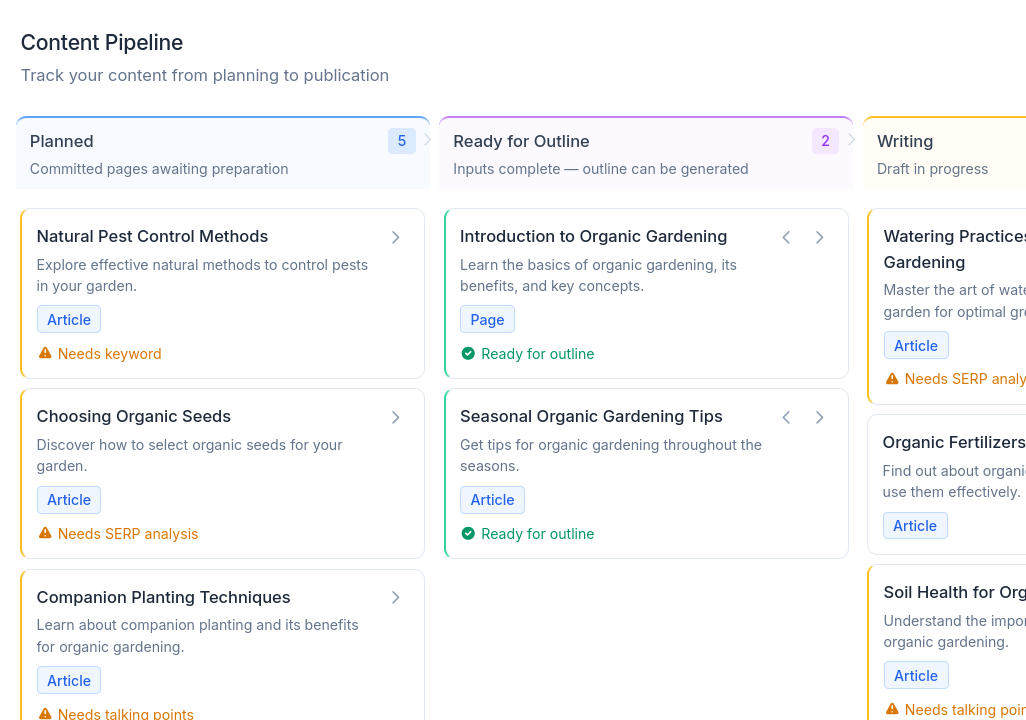
Your ideas aren't things you brainstormed from thin air. They're generated from real search data — actual queries people type into Google related to your industry and area. So instead of guessing what to write about, you're choosing from topics you know people are already looking for.
You pick one. Maybe "How to Choose the Right Roofing Material for Your Home." You move it to the next stage. Over the next week, whenever you have 20 minutes, you add some sections, write a few paragraphs, and move the card forward. Eventually, it's a finished page on your site.
No editorial calendar. No content strategy document. Just a board with clear stages and your content moving through them, one step at a time.
Ideas based on what your customers actually search for
This is the part that changes things for business owners.
Instead of sitting down and trying to think of "blog topics" — which is already frustrating if you don't consider yourself a writer — you start with data. Real searches. Things people in your market are actually typing into Google.
When you see a list of topics like "how much does teeth whitening cost," "signs you need a new furnace," or "how long does a home inspection take," you don't have to be creative. You just have to be knowledgeable. And you already are — these are questions you answer at work every day.
The ideas come from demand. Your job is to pick the ones that fit your business, add your expertise, and publish them. That's it.
Every page you create this way has a built-in audience. Someone is already searching for it. You're just making sure they find you when they do.
You don't need a marketing degree — you need a simple system
Adding content to your website doesn't require becoming a content marketer. It requires a straightforward process: see what your customers are searching for, plan a few pages that answer those searches, write them in your own words, and publish them.
A content pipeline keeps that process visible and manageable. You always know what you have in progress, what's ready to write, and what's already live. Nothing gets lost. Nothing requires you to remember where you left off.
You might add one new page a month. That's fine. In a year, that's twelve pages answering twelve real customer questions — twelve new ways for people to find your business through search. That's more than most of your competitors will ever do.
The bar isn't perfection or volume. It's consistency and relevance. A simple system makes both possible, even without a marketing team.