
Here's something most business owners do at least once: open Google, type in their business name, see their website come up, and think "great, we're showing up on Google."
That's like calling your own phone number to make sure it works. Of course your business name shows up when you search for it — Google knows your website exists. But your future customers aren't searching for your business name. They don't know you exist yet. They're searching for what they need:
- "Emergency plumber near me"
- "Best hair salon in [your town]"
- "Kitchen remodeling contractor"
- "Financial advisor for small business"
The real question isn't whether Google knows about you. It's whether Google shows your website when someone in your area needs the service you provide. And unless you check, you have no idea.

What a Google ranking actually is
When someone types a search into Google, the results that come back are in a specific order. Your position in that list is your ranking.
If you're position 1, you're the first result people see. Most clicks go here. Position 5, you're still on the first page — visible, but less likely to get clicked. Position 11, you're on page 2. Almost nobody goes to page 2. Position 30 or higher, you're effectively invisible.
And if your website doesn't show up at all for a search? That's a dash — no ranking. Google either hasn't connected your site to that topic, or it doesn't think your page is relevant or good enough to include.
That single number — your position in Google's results for a specific search — is the most useful piece of information about how your website is performing. Not your total visitor count, not your page views, not how many people bounced. Just: when someone searches for what you do, where do you show up?
Why you can't just Google yourself
You might be thinking "I'll just search for 'plumber near me' and see where I show up." It's a reasonable instinct, but it doesn't work.
Google personalizes results based on your location, your browsing history, and even the device you're using. If you've visited your own website before (which you have), Google is more likely to show it to you. If you're sitting in your office, your location data biases the local results in your favor.
What you see when you search is not what a potential customer sees when they search from their home across town. You need a tool that checks your position from a neutral perspective — no personal browsing history, no location bias. You tell it which search terms matter to your business, and it checks Google on your behalf, regularly, and reports back with an honest number.

What to do with what you find
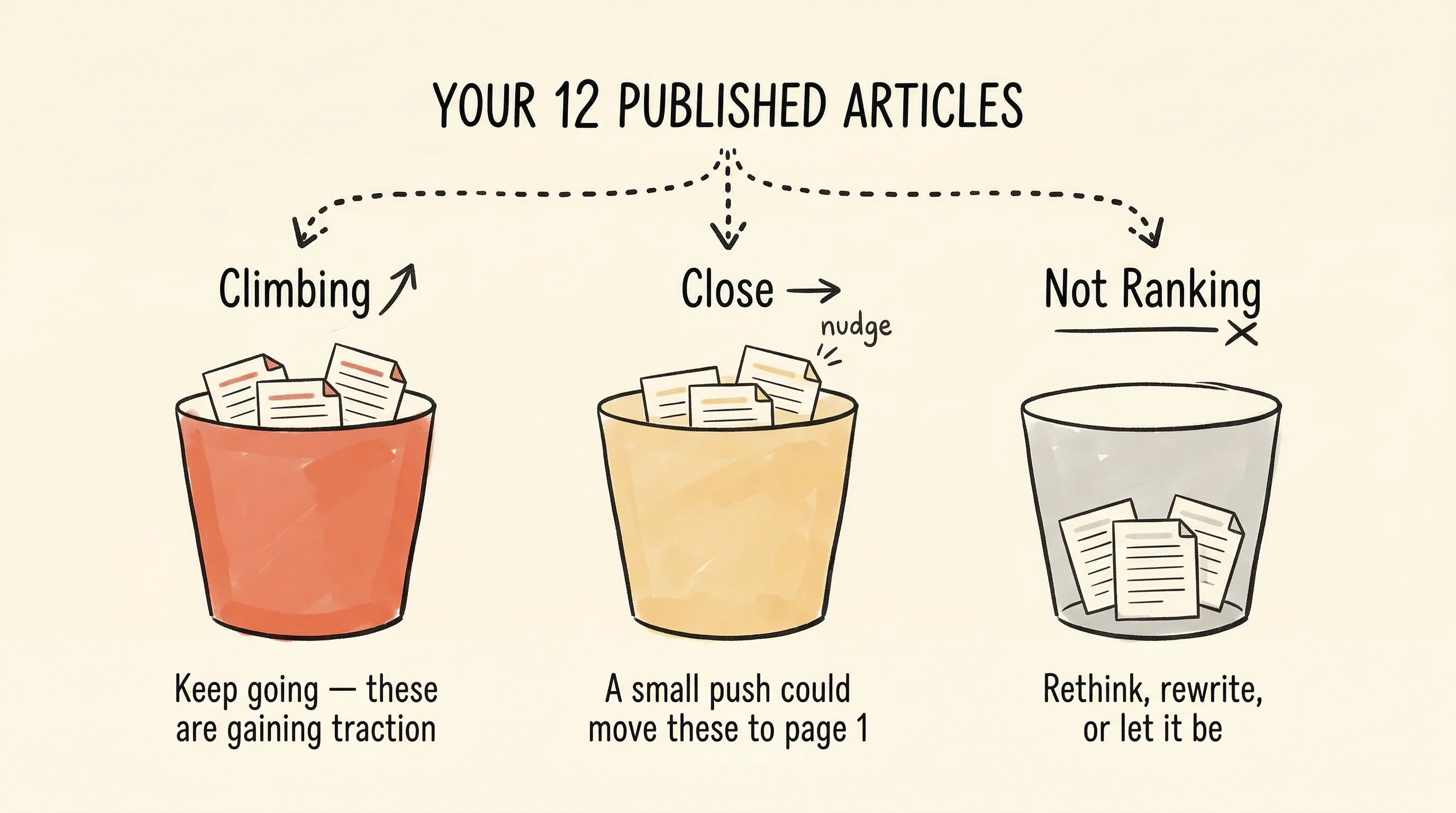
Once you know where you rank for the searches that matter to your business, every page falls into one of three situations. Each has a clear next step:
You're on page 1 (positions 1-10). This is working. People are finding you through this search. The goal now is to protect that position: keep the page updated, make sure the information is current, and don't make drastic changes to something Google already likes. Check in on it once in a while, but don't fix what isn't broken.
You're on page 2 or 3 (positions 11-30). You're close — close enough that Google considers you relevant, but not close enough to get much traffic. This is where small improvements can make a big difference. Look at the pages that rank above you: do they answer the question more thoroughly? Do they include information yours is missing? Strengthening your page — adding a section, improving your answer, making the content more specific — can push you onto page 1 where the clicks actually happen.
You don't rank at all. Either you don't have a page on your site that addresses this topic, or the page you have needs significant improvement. If you don't have a page for it, that's an opportunity: writing a good article that answers that question is the first step. If you do have a page but it's not ranking, look at what the top results do differently — they're probably more detailed, more specific, or more clearly focused on answering the question.
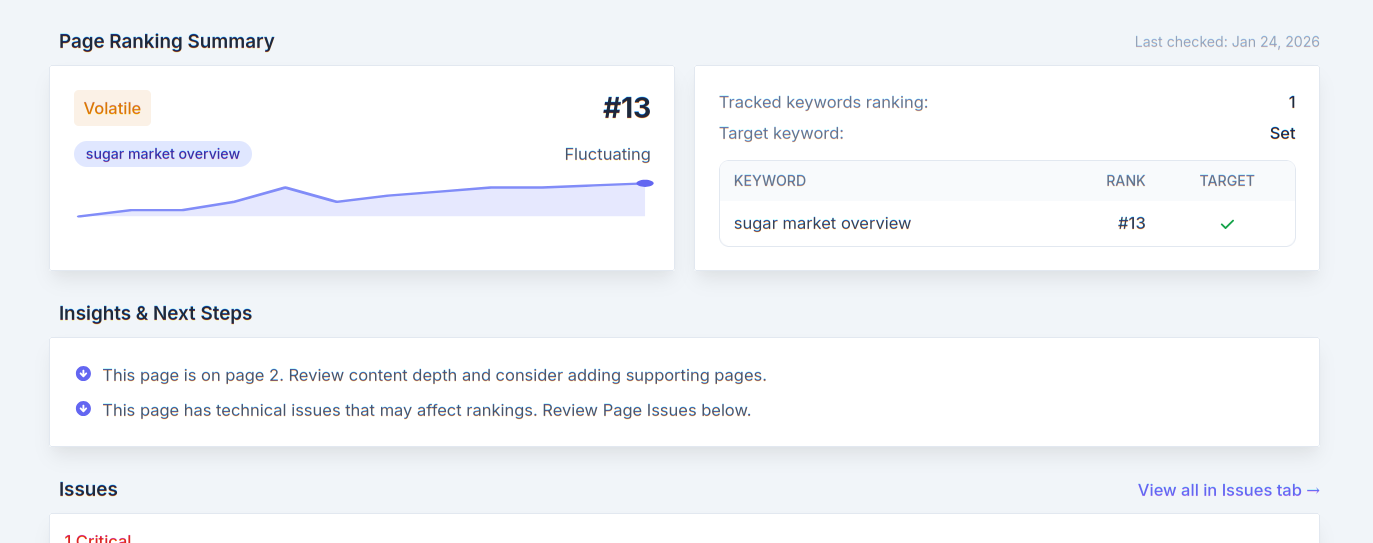
SitePerfector shows all of this in a simple table: your page, the search term it targets, and its position on Google. No graphs you have to interpret, no color-coded dashboards, no metrics that require a marketing degree. When a page isn't performing, the tool gives you a plain-language list of what to fix, in order of what matters most.
Why this matters more than ads
You can pay for Google Ads and show up at the top of the results immediately. But the moment you stop paying, you disappear. Every click costs money, and for competitive search terms, those costs add up fast.
A page that ranks organically — meaning it shows up in the regular results because Google thinks it's a good answer — brings you visitors every single day without ongoing cost. Once it's on page 1, it stays there as long as you maintain it. That's not a marketing expense; it's an asset.
For a local business, having even three or four pages that rank well for searches your customers make — "how to choose a contractor," "signs your furnace needs replacing," "what to expect from a home inspection" — can mean a steady trickle of inquiries from people who were already looking for exactly what you offer.
Rank tracking is how you know those pages are working. It's how you catch a drop before it costs you business. And it's how you decide where to invest your limited time in improving your website — not guessing, not hoping, but looking at real numbers and making obvious decisions.
Your website can do more than sit there. It can bring customers to your door. But only if you know which pages are doing their job and which ones need help.