Content as a tactic: pumping out articles for traffic, is dying. Content as a strategy: owning a micro-niche with real expertise, is more important than ever.
Two things are true at the same time in 2026, and they seem contradictory until you understand what changed.
The first: content marketing teams are scaling up. "Scale high-quality content" jumped to the #1 sought benefit from AI tools, with 57% of marketers planning to expand content production this year. Content budgets are rising. Nobody in a boardroom is saying "stop creating content."
The second: the people actually publishing, watching their analytics, and posting in forums, increasingly say "content is dead." AI slop flooded every niche. Google shows AI-generated answers instead of sending clicks. The Helpful Content Update wiped out small sites. Publishing another article feels like shouting into a void.
Both camps are right. They're just talking about different things.
Everyone Can Publish Now. That Changed Everything.
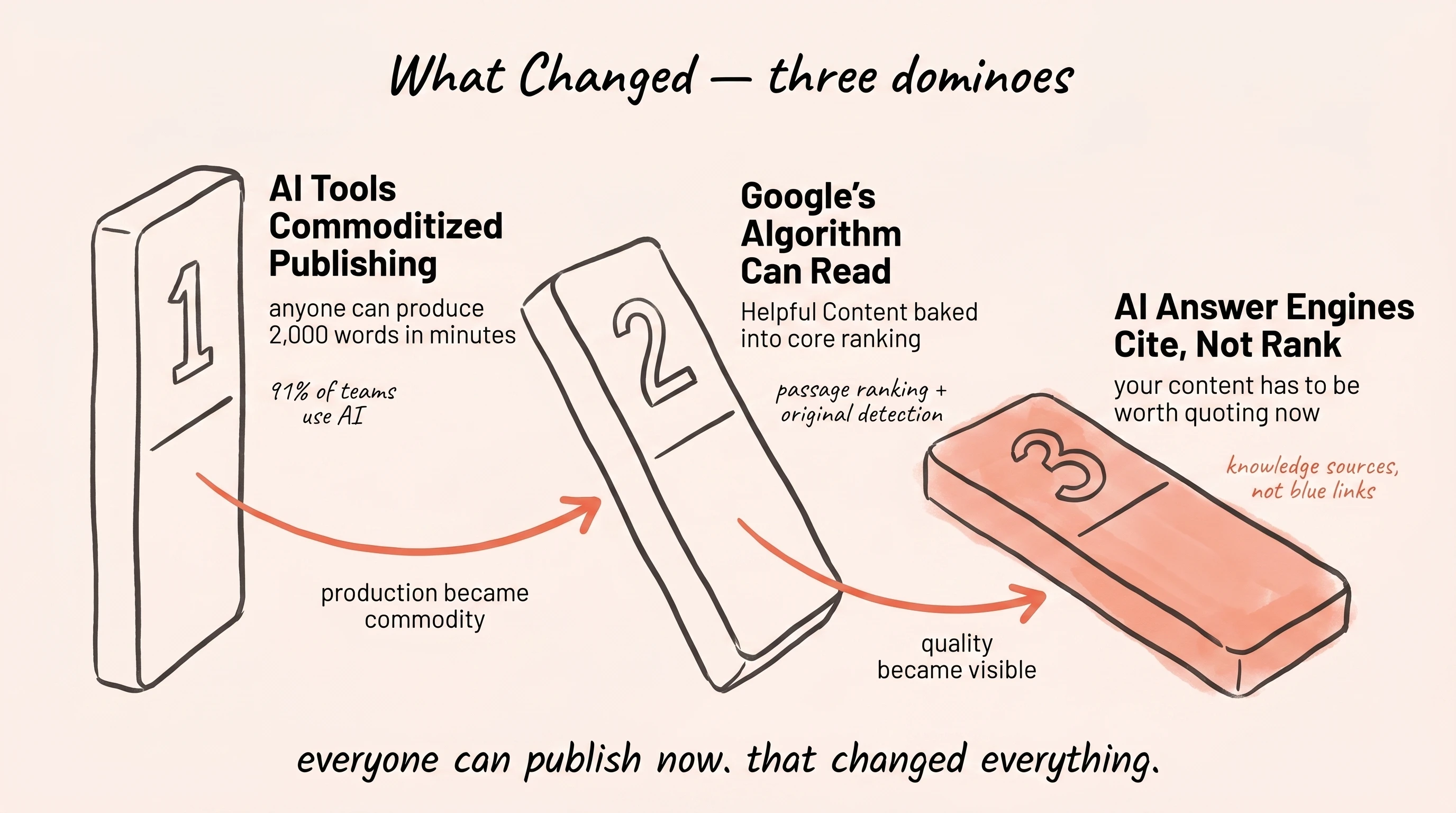
The first domino was AI writing tools. When 91% of marketing teams use AI for content creation and anyone can produce a passable 2,000-word article in minutes, the act of publishing stops being a competitive advantage.
Production got commoditized.
Everyone has access to the same tools, the same speed, the same output quality floor.
The second domino was Google's response. The Helpful Content system became core ranking. Passage ranking evaluates individual sections of your page. Original content systems detect who published first. Google built AI that can actually read your content and judge whether it's helpful, something it couldn't do before.
The third domino is AI answer engines themselves. When an AI generates an answer directly, it cites "knowledge sources" with strong topical coverage and entity clarity. Your content doesn't just need to rank in a list of ten blue links anymore. It needs to be worth citing.
Google says it plainly: "Creating content that people find compelling and useful will likely influence your website's presence in search results more than any of the other suggestions in this guide." Content quality is now the #1 lever. Not technical SEO. Not backlinks. Content.
This Isn't New. But Now It's Mandatory.
If you've been in SEO for a while, you might be thinking: "Good SEO has always been about quality content." You're right. Practitioners have been saying this since at least 2015. The principles behind semantic SEO, topical authority, and user-first content aren't new ideas.
What changed is that Google can now enforce them.
Before, the algorithm was blind to quality. You could rank with mediocre content if your links were strong, your page was fast, and your title tags were optimized. The SEO industry was built around gaming proxies because quality itself was invisible to the machine. Great content was nice to have. It wasn't required.
Now it is. The algorithm can read. It evaluates your sections independently. It knows if you're the original source. It checks whether your content is actually helpful at the ranking level. The principles haven't changed. But they went from "best practice" to "survival requirement."
What Dies and What Lasts
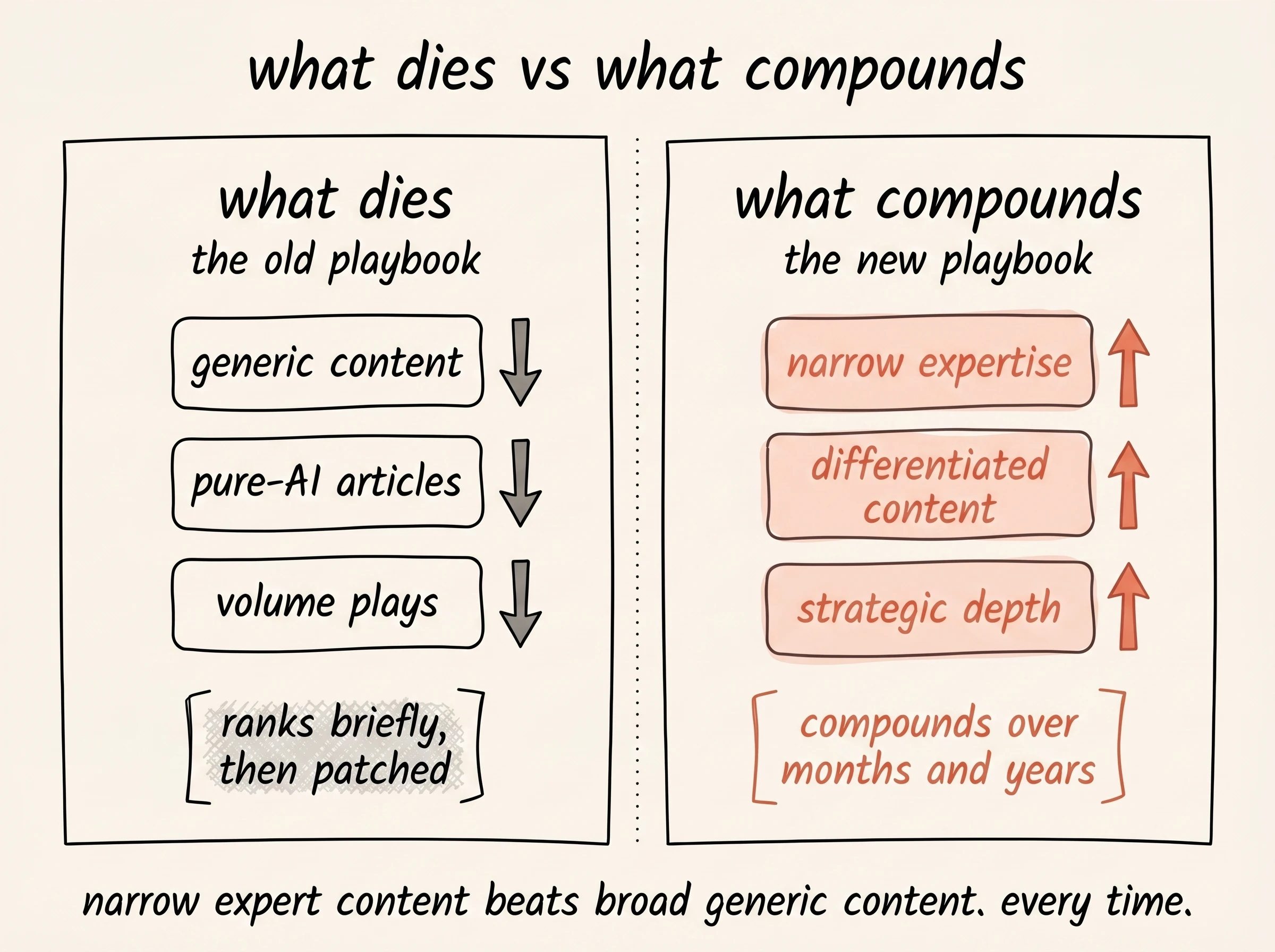
What dies: Generic content. Pure-AI content without expertise. Volume plays (pushing out a ton of ai-slop).
One case study makes this concrete: a marketer built three AI-generated affiliate sites in welding, plumbing, and electrical trades. Zero brand signals. ChatGPT content. Scraped data. No original research. They initially worked. A few hundred clicks each in the first months. Then Google's spam update hit. Traffic dropped to zero. No recovery. Google tolerated them just long enough to learn from them.
That's the old playbook in 2026. It still works briefly, and then it doesn't.
What lasts: Narrow expertise. Differentiated content. Strategic depth.
One B2B SaaS founder described the pattern this way: once a few pages started ranking for very specific, intent-driven keywords, traffic became steady and predictable. The real win, in their experience, was owning high-intent queries and actually saying something differentiated. What failed: chasing broad "ultimate guide" keywords and posting daily just for consistency.
The pattern is clear. Broad, generic, high-volume content loses to narrow, expert, intent-matched content. Every time. The sites that win over the long run are the ones that planned what to cover, covered it deeply, and stopped chasing volume.
Our position: The highest-leverage activity in content marketing shifted from optimization to planning. Deciding what to write, for whom, in what order, and how it connects. That's where results come from now. Not title tags. Not keyword density. Planning. And planning is the only layer AI can't replace. AI writes faster than you. It can audit your technical SEO. But it can't decide what your audience needs or what makes your perspective worth reading. Everything else got commoditized. The planning layer didn't.
What This Means for You
If you're creating content in 2026, the question is no longer "how do I produce more?" It's "how do I plan better?"
The sites that win are doing fewer things, more deliberately. They're picking topics strategically, covering them thoroughly, connecting them through interlinked clusters, and building genuine expertise into every page.
They're not publishing five posts a week hoping something sticks. They're publishing one or two pieces that are genuinely, measurably better than what already exists.
Content marketing changed because the machine changed. It can tell the difference now.
Plan accordingly.