Ranking #1 for a keyword is not a business goal. Getting customers is. The difference between the two explains why most content strategies fail.
Here's a number that should recalibrate how you think about content. HubSpot, one of the most successful content marketing operations in the world, once drove 80,000 visits per month from a blog post about "how to make a GIF." For a CRM company. Those visitors had zero interest in buying customer relationship management software. The traffic was real. The business value was zero.
This is the trap. Ranking feels like winning. Traffic looks like progress. But unless the people arriving are the people you're trying to reach, you're optimizing for a vanity metric.
Traffic Is Not the Goal. Customers Are.
A blog is a customer acquisition channel, not a traffic channel. The primary KPI is sales, not visitors. This sounds obvious until you watch how most businesses actually plan their content. They pick keywords by volume, write articles to capture searches, and hope that enough of the resulting traffic converts to justify the effort.
That's backwards. Start from the business outcome and work back to the content.
What that looks like depends on what you're trying to do:
- Lead generation (consultants, agencies, B2B): Target bottom-funnel, commercial keywords. "Best project management tool for agencies" beats "what is project management." The searcher is closer to buying.
- Revenue (e-commerce, SaaS): Target product and money keywords. Content that directly supports purchase decisions: comparisons, reviews, use cases.
- Local (service businesses): Local search + reviews matter more than blog content. "Plumber in [city]" with genuine reviews outranks any amount of blog posts about plumbing tips.
- Authority (thought leaders, publishers): Topical depth that positions you as the go-to expert. The business value comes through brand recognition and inbound opportunities, not direct conversions from blog traffic.
None of these goals are "rank #1 for keyword X." The ranking is a means, not an end.
The Math: Why Content Compounds (Slowly)
Content marketing generates three times more leads than outbound marketing at 62% less cost. One entrepreneur replaced $2 million in annual ad spend with $70,000 per month in content production, and got equivalent leads. 85% of blog traffic comes from organic search, which means it keeps working long after you stop paying for it.
But here's the part most people aren't told: only 0.1% of pages on any given topic get more than 1,000 monthly visits. Google says results take four months to a year. And "no one can guarantee a #1 ranking."
Content marketing works. But it works on a compounding curve, not a hockey stick. There's a pattern that Ahrefs calls the "spike of hope, flatline of nope." You publish a piece, share it, get a brief traffic spike from your existing audience, then traffic flatlines for months while Google evaluates and slowly ranks it. Most people see the flatline and conclude it didn't work. The ones who keep going see the compounding kick in.
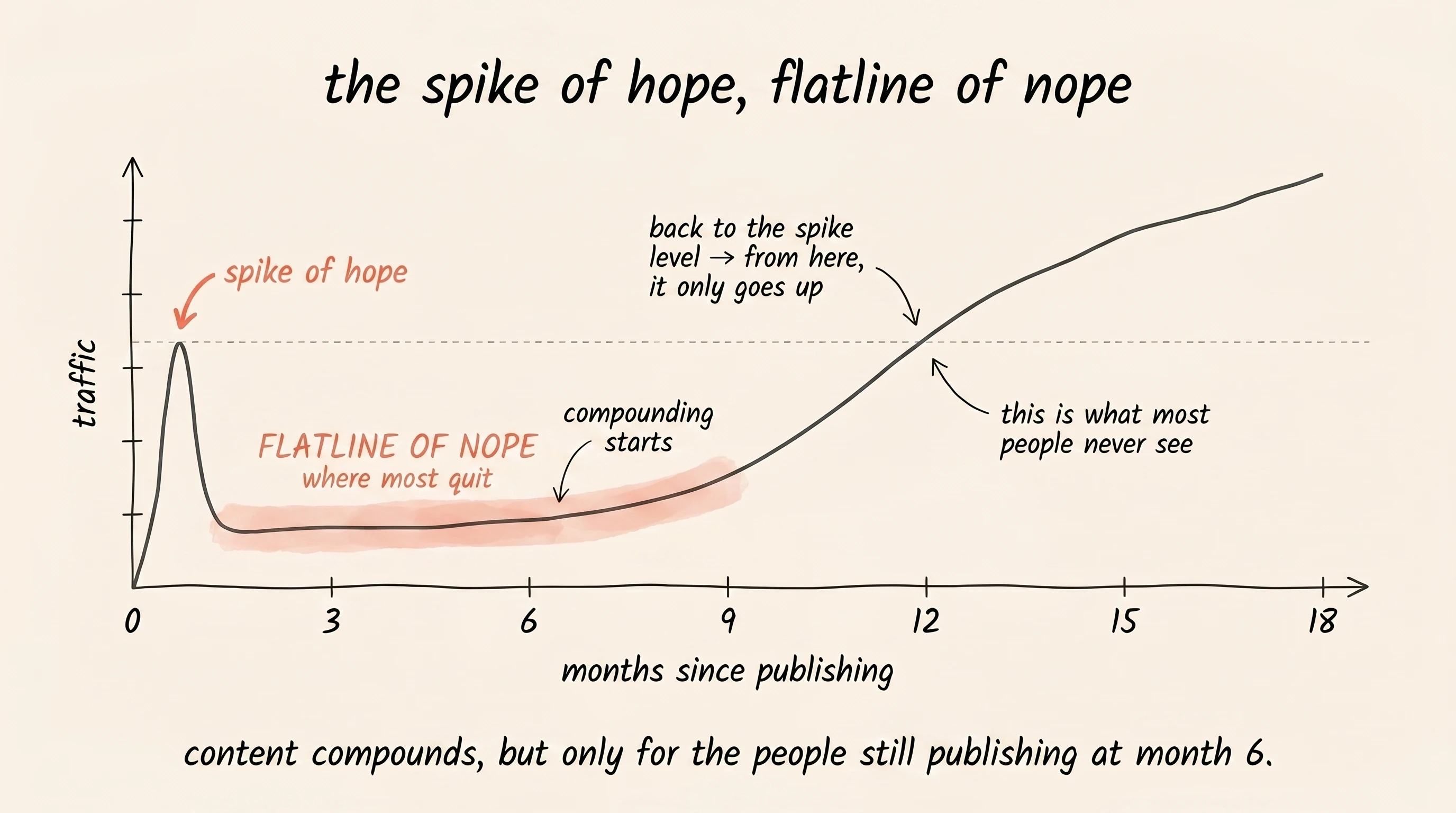
Ahrefs grew their blog from 15,000 to 150,000 monthly visitors while reducing their publishing frequency. Fewer pieces, each one more strategically planned, each one compounding over time. The lesson: publishing more doesn't win. Publishing the right things does.
Not All Rankings Are Equally Hard
If you're in health, finance, legal, or any field where bad advice can cause real harm (what Google calls YMYL, "Your Money or Your Life"), the quality bar is structurally higher. Google applies stronger expertise signals to these topics. A financial advisor's content needs demonstrable credentials, expert review, and extreme accuracy. A craft blogger can compete more on experience and originality.
This isn't unfair. It's context. Before investing in content, understand where you're competing. The difficulty of ranking isn't universal. It depends on how much is at stake for the person searching.
What This Means for You
Before you write anything, answer one question: "If this content ranks #1, will it bring people who might eventually buy from me?"
If the answer is yes (even indirectly, even through a long journey), it's worth writing. If the answer is "it'll bring traffic, but not my traffic," it's a vanity play. The HubSpot GIF post is famous for a reason. Don't build your strategy around it.
Content is a long game. Google says four months to a year. The math rewards patience. And the businesses that win aren't the ones publishing the most. They're the ones planning the best.