
You've been meaning to start creating content for your site. Maybe for months. But every time you sit down to begin, the same thought stops you:
"I should really figure out my content strategy first."
So you Google "how to build a content strategy." You find articles telling you to define your audience personas, map out content pillars, build an editorial calendar, conduct a content audit, and set measurable KPIs. An hour later, you have seventeen browser tabs open and zero published content.
The strategy research became the project. The content never happened.
The planning trap
There's a specific kind of procrastination that disguises itself as preparation. It sounds responsible: "I want to be strategic about this." "I don't want to waste time writing the wrong things."
These aren't wrong impulses. Having a strategy is genuinely better than not having one. The problem is treating strategy as a prerequisite instead of something that develops alongside the work.
Nobody figures out their content strategy in a spreadsheet. You figure it out by writing a few things, seeing what resonates, and paying attention to what actually brings people to your site. Strategy is a byproduct of action, not a precondition for it.
The people who publish consistently didn't start with a perfect plan. They started with a single post about something they knew, and then they did it again.
Start with one idea, not a plan
Think about your business for thirty seconds. What's one question your clients or readers ask you all the time? What's one thing you explain in every initial call, every DM, every consultation?
That's your first article. Not because it's strategically optimal. Because it's real, it's useful, and you can write it without researching anything. You already know the answer.
You don't need to know where this fits in a content pillar. You don't need to know what keyword it targets. You need to write it down and move it forward one step.
Ideas are cheap — and that's a good thing
When you generate ten content ideas, maybe two or three are worth writing. The rest were useful for getting there — they helped you think, they cleared the obvious topics out of the way, they led you to the better ones.
The problem is that most planning systems treat every idea like a commitment. You write it on the board, and now it sits there, staring at you, making you feel behind.
This is why it matters to have a space where ideas can exist without obligation. A capture space where you dump everything without pressure. The good ones float to the top — you'll notice them because you keep thinking about them, because someone asks about that exact topic, because you realize you already know what you'd say.
The content pipeline in SitePerfector is built around exactly this principle. Ideas stay upstream, separate from the production workflow. You can have two hundred ideas in the inbox and three things in your pipeline, and that's a perfectly healthy state. The inbox is for thinking. The pipeline is for doing.
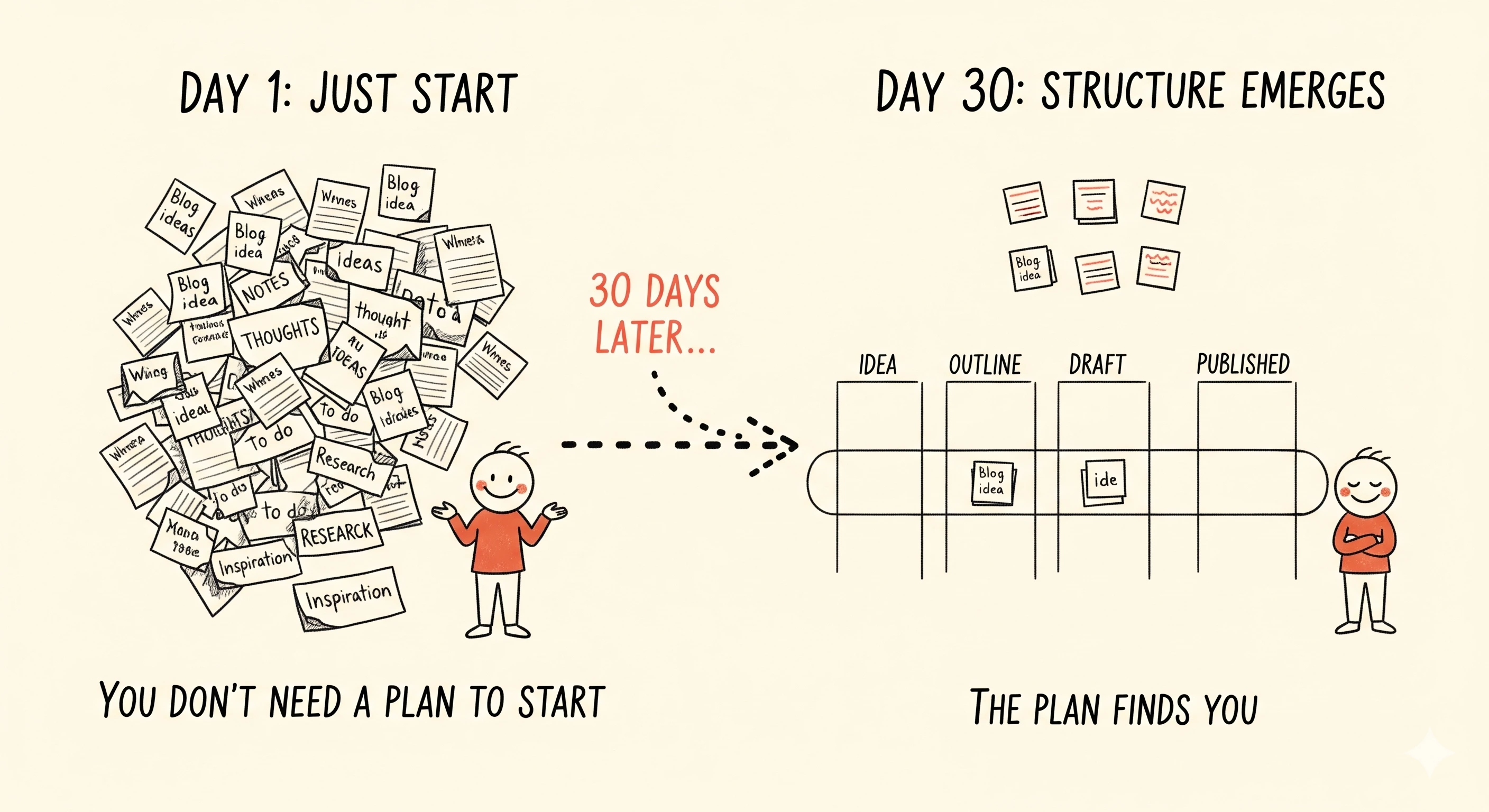
Structure emerges from action
Here's what actually happens when you start without a strategy:
You write your first post about something you know well. You publish it. Maybe it gets some traffic, maybe it doesn't. But you notice something — writing it made you think of two related topics you could cover.
You write one of those. Now you have two posts that naturally connect. Without planning a content pillar, you've started building one.
A few more posts in, you see a pattern. Your performance tracking shows one post climbing while another sits flat. Now you have real data — not theory about what your audience might want, but evidence of what they actually engage with.
That's when strategy gets useful. Not before you've started, but after you have something to strategize about.
The best content strategies aren't designed in advance. They're recognized in hindsight and then reinforced going forward. You can't recognize a pattern in content you haven't created yet.
When strategy actually matters
After you've written ten or fifteen posts, you'll know things that no amount of upfront planning could have told you:
- Which topics you can write about quickly and with confidence
- Which posts actually bring search traffic
- What your audience asks follow-up questions about
- Where your natural expertise clusters are
That's when you sit down and build a strategy. Not from theory — from reality. You've already done the hardest part, which is starting. Now you're refining direction based on what's actually working.
Start messy
The reason so many people stall on content isn't that they lack discipline or ideas. It's that they've set an invisible bar — "I need a strategy" — that prevents them from taking the first step.
Lower the bar. Write one thing about something you already know. Put it somewhere you can see it. Move it forward one stage.
On day thirty, you'll have a handful of published posts, some data about what's working, and — without having planned it — the beginning of a real content strategy. One that emerged from what you actually did, not what you hoped to do.
The best time to have a content strategy was six months ago. The second best time is after you've published your first five posts. The worst time is right now, before you've started — because you'll plan for a version of your content that doesn't exist yet.
Start messy. Structure comes later. And when it does, it'll be based on something real.