
You have a keyword tool. A content planner (maybe a spreadsheet, maybe Trello). An AI writing assistant. A rank tracker. Maybe a site audit tool too.
Five tools. Five logins. Five tabs. None of them know about each other.
Your keyword tool doesn't know what you've already published. Your rank tracker doesn't influence your next content idea. Your AI writer has no idea which keywords you're targeting or what already ranks for them.
Every time you move between tools, you carry context in your head. You copy a keyword from one tab, paste it into another, try to remember what you read in the SERP analysis, open the content planner to see what you've already written about...
This is the hidden cost of a disconnected workflow. Not the subscription fees — the context you lose every time you switch.
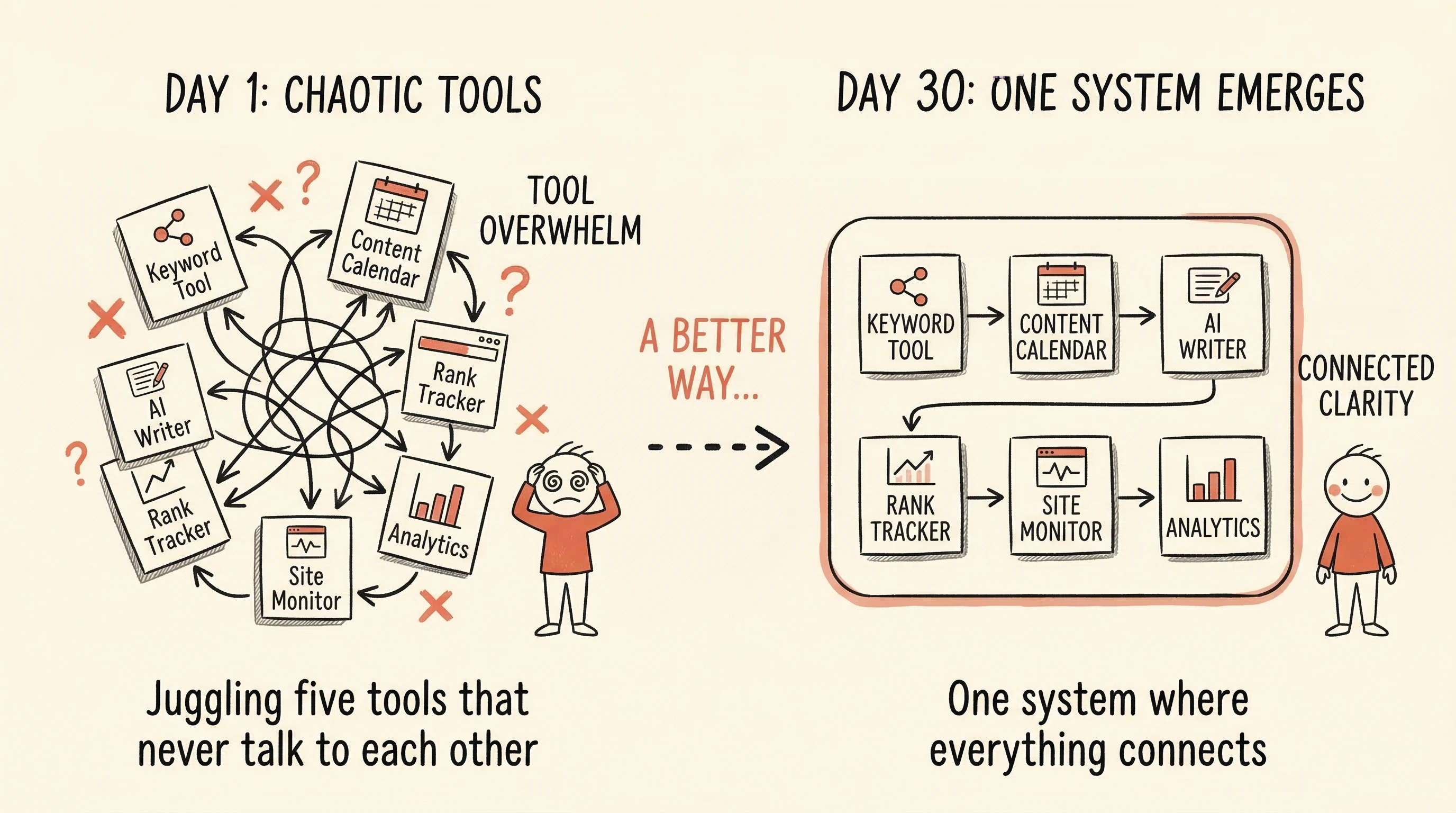
The context-switching tax
Every tool switch is a small interruption. You're not just clicking to a different tab — you're mentally reloading a different interface, a different mental model, a different set of assumptions.
Your keyword tool thinks in terms of volume and difficulty. Your content planner thinks in terms of status and deadlines. Your rank tracker thinks in terms of positions and trends. Your writing tool thinks in terms of words and headings.
None of them think in terms of your site. None of them know what you've already done, what's working, or what you should do next.
So you become the integration layer. You're the one holding it all together — translating between tools, copying data, making connections that the tools themselves can't see.
That works when you have three pages and one keyword. It breaks down fast when you have thirty pages, fifty keywords, and a publishing schedule to maintain.
What changes when it's one system
When keyword research, content planning, writing, rank tracking, and site health live in the same system, each part starts making the others better. Not in an abstract, theoretical way — in very specific, practical ways.
Your topic suggestions get smarter. A standalone keyword tool knows nothing about your site. A content strategy tool that lives inside your content system knows what you've already published, which topics you've covered well, where the gaps are, and what your site's growth stage is. The same keyword might be a bad idea for a new site and a great opportunity for a growing one. A connected system sees that difference.
Your outlines are built from data you already have. When you use a separate AI writing tool, you start from scratch every time. When your outline generator lives in the same system as your rank tracker, it already knows what's ranking for your target keyword — the structure competitors use, the questions they answer. You don't paste anything. You click "generate outline" and the system pulls together everything it already knows.
Your rankings create a feedback loop. In a separate rank tracker, you see a page dropped from position 8 to 15. What do you do? Open another tool. Check the content. Cross-reference competitors. In a connected system, rank data feeds directly back into your content decisions. A declining page appears alongside specific suggestions. A keyword close to page one gets surfaced as a quick win. You publish, track, learn, and improve — in one loop.
Your pipeline reflects reality. A standalone content planner tracks what you said you'd do. Your content pipeline inside the system knows what's actually done: keyword assigned, SERP analysis complete, outline generated, two of five sections written. Actual status — derived from reality, not from the last time someone remembered to move a card.
The compound effect
Each improvement above is useful on its own. The real value is how they multiply each other.
Better topic suggestions lead to more relevant content. More relevant content performs better in search. Better search performance generates more ranking data. More ranking data improves the next round of suggestions.
This isn't a linear workflow. It's a loop. And loops compound.
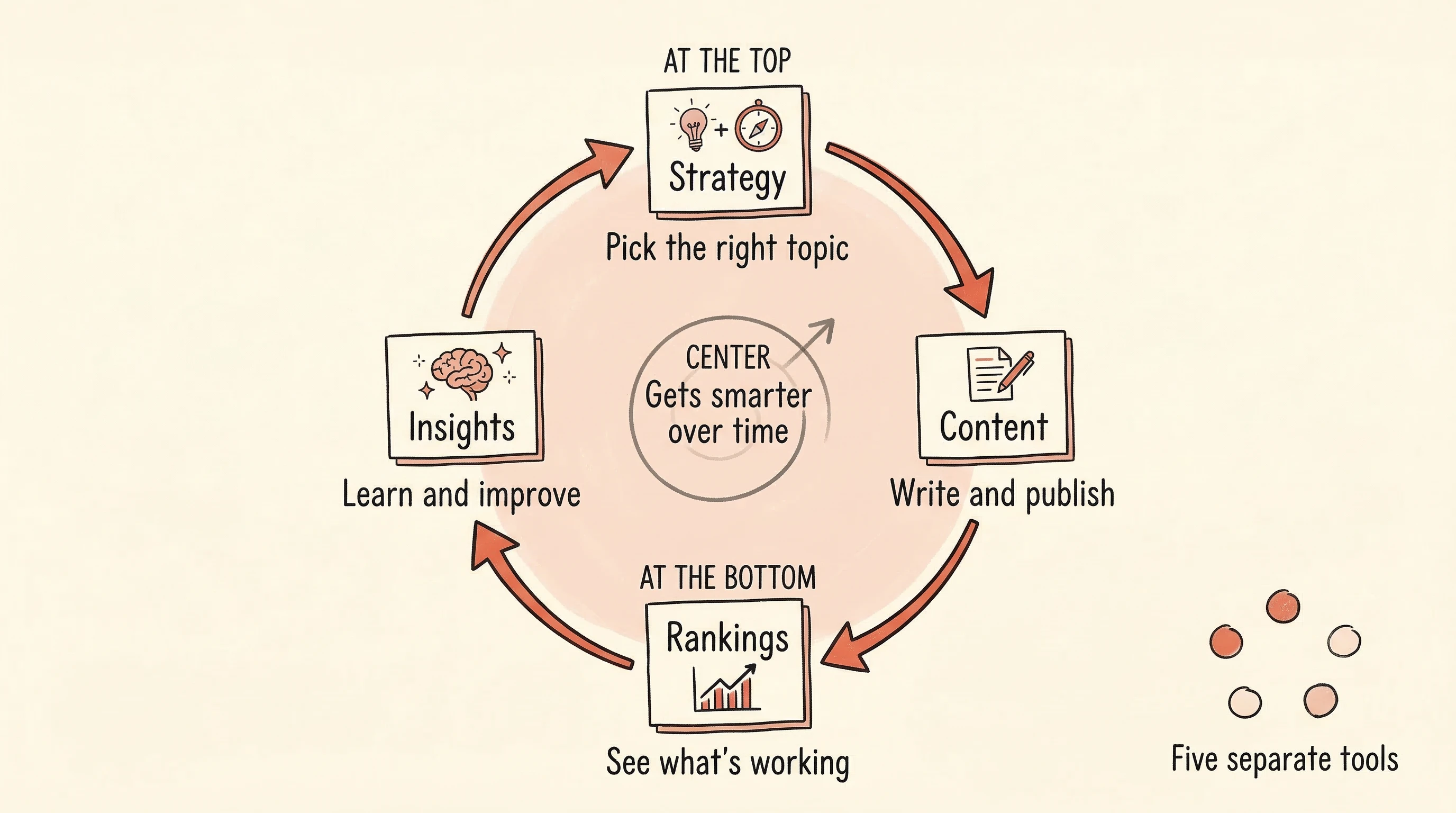
After three months, a connected system knows your site deeply — what topics resonate, what competition looks like in your niche, which pages are gaining traction and which need help. A collection of standalone tools still knows exactly as much as it did on day one: nothing about the other tools.
The hidden cost of "best of breed"
The conventional wisdom is to pick the best tool for each job. Best keyword tool. Best writing assistant. Best rank tracker.
But "best" assumes the tool works in isolation. A keyword tool that's technically superior but doesn't know your content history is worse than a good keyword tool that does.
The cost of juggling five tools isn't the subscriptions. It's the time spent moving between them, the context you lose in every switch, the connections you miss because the data lives in five different places, and the decisions you delay because you'd need to cross-reference three tabs to make them.
For SEO teams with dedicated analysts, that overhead might be manageable. For a solo operator or small business trying to grow organic traffic while running the rest of their business — it's the thing that causes content strategy to stall out entirely.
What "one system" actually means
This isn't about cramming five bad tools into one interface. It's about a system where each part was designed to work with the others.
Content strategy that factors in your existing content and rankings. Outlines built from SERP data the system already tracks. A content pipeline that reflects actual progress. Performance tracking that feeds back into your next content decisions. Site health monitoring running quietly underneath, so you're not juggling yet another tool.
One login. One place where your content strategy lives. And a system that gets smarter about your site the longer you use it — because every piece of data makes the other pieces more useful.
Not "we do everything." But: everything we do makes the other things work better.
That's something five separate tools will never do.