
You opened the keyword tool last Tuesday between clients. You typed in something related to your coaching niche — maybe "career transitions" or "executive presence" — and got back a wall of suggestions. Hundreds of them. Sorted by search volume, which you've been told matters.
You picked a few that seemed relevant. You spent your evening writing a post around one of them. It felt... off. Like you were performing for an algorithm instead of talking to the people you actually help.
Two weeks later, the post is sitting on page five. No traffic. No inquiries. Another Tuesday evening you won't get back.
The tool gave you data. It didn't give you context.
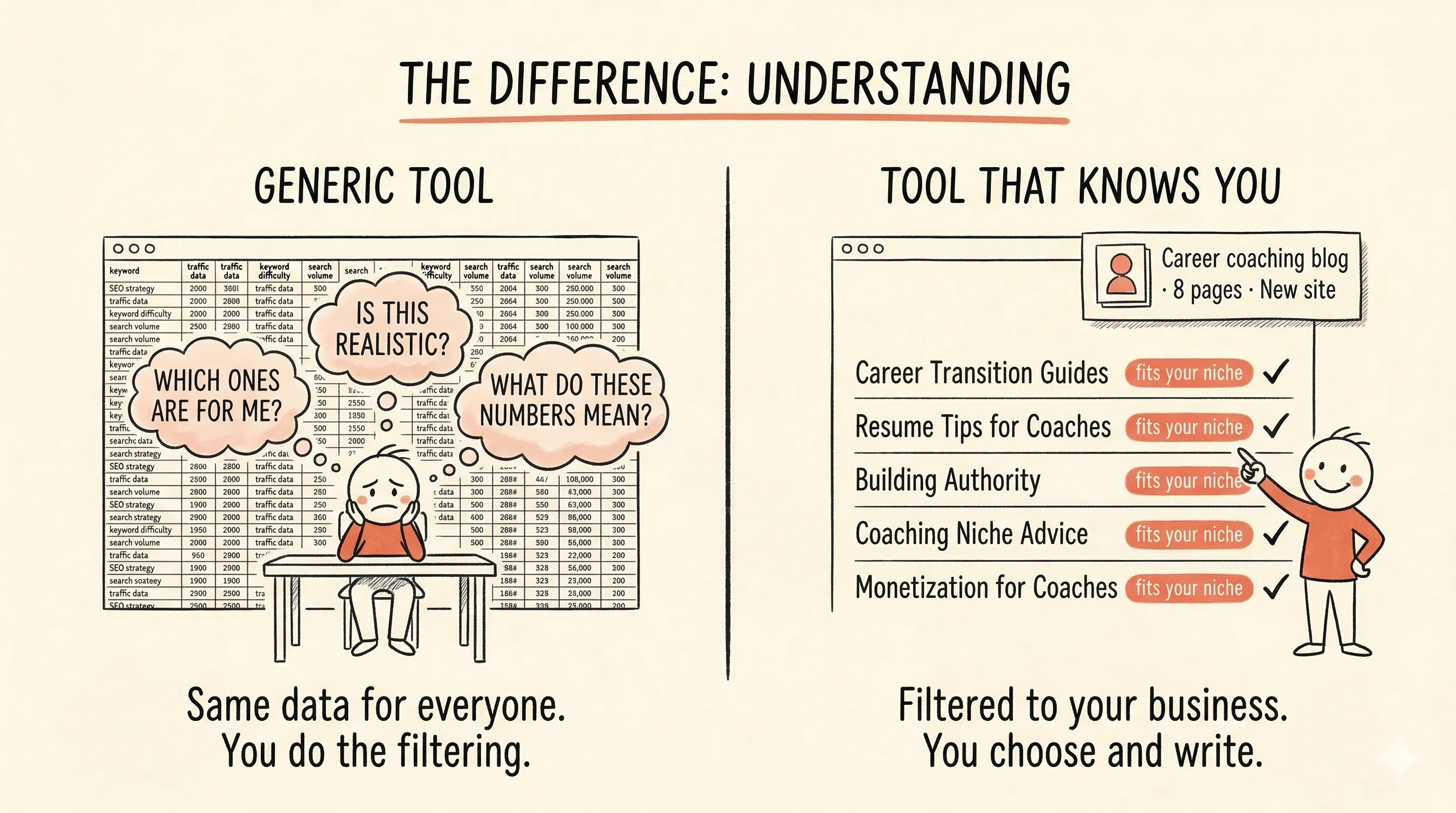
Here's the thing most keyword tools won't tell you: they don't know what you do. They don't know you're a career transition coach who works with mid-career professionals leaving corporate. They don't know your site has eight pages and was built six months ago. They don't know that "executive coaching" is dominated by massive firms you can't compete with yet.
They show you the same data they show everyone. And you're left doing all the interpretation — figuring out what's relevant to your niche, what's realistic for your site, what would actually resonate with the people who need your help.
That interpretation takes expertise you don't have, because it's not your field. You're a coach, not a marketer. So you guess. And guessing with good data still produces bad decisions.
What changes when the tool knows you first
Imagine a different version of that Tuesday. You open the tool and it already knows your site — it crawled your pages, identified your topics, extracted your brand voice from your existing content. It knows you write for mid-career professionals. It knows your site is relatively new.
The keyword suggestions aren't a wall of 500 options. They're a short list, already filtered: topics that fit your niche, that match your audience, and that your site can realistically rank for at its current stage.
You're not interpreting spreadsheet data anymore. You're choosing between three or four topics that already make sense for your business. That's a fundamentally different task — and it fits in the 45 minutes you actually have.
The foundation layer nobody talks about
Most content tools skip this step entirely. They jump straight to keywords, or outlines, or AI-generated drafts. But every recommendation is only as good as the understanding behind it.
When SitePerfector starts by learning your business, it's building the foundation that makes everything else work. Your brand voice informs how AI drafts sound. Your growth stage determines which keywords are realistic. Your existing content coverage reveals gaps worth filling instead of topics you've already covered.
This isn't a setup questionnaire you fill out once and forget. The system crawls your site, analyzes your pages, identifies your audience personas, and detects your core topics — automatically. It updates as your site grows.
Generic advice is worse than no advice
The real cost isn't just wasted time on a Tuesday evening. It's the slow erosion of trust — yours in the tool, and eventually in content marketing itself. When every suggestion feels slightly off, when every post takes more effort than it should, when the results never match the promise, the logical conclusion is "this doesn't work for me."
But it's not that content marketing doesn't work for coaches. It's that a tool giving you generic suggestions can't produce specific results. The missing piece isn't a better keyword list. It's a tool that understands the business behind the keywords.
The 45-minute window is enough
That window between your last client and the end of your day — it's real. You don't have two hours for keyword research. You don't have a marketing team to hand things off to.
What you need is a system that already did the understanding work. One that knows your niche, your stage, and your audience before you even log in. So when you open it on Tuesday, the hard part is already done — and you're spending your time on the part only you can do: sharing what you know with the people who need to hear it.
That's what SitePerfector's business intelligence is built around. Not more data. Better understanding. See how it works.