
You've been blogging for eight months. You have 24 published posts, a few of them getting steady traffic, most of them floating somewhere between page three and nowhere. You know you need to be more strategic about what you write next. So you sign up for a keyword tool.
It shows you a dashboard. Search volumes. Difficulty scores. Keyword gaps. You type in your niche and get back 300 suggestions that look exactly like the suggestions you got from the last tool you tried. "Best budgeting apps." "How to save money fast." "Personal finance tips for beginners."
You already wrote about two of those. The third is dominated by NerdWallet and Investopedia. Nothing on the list feels like it was meant for your blog specifically. Because it wasn't.
The sameness problem
Here's what most bloggers don't realize: keyword tools don't know your blog exists. They know the search landscape — what people type into Google, how often, how competitive the results are. That's useful data. But it's the same data for everyone.
A blogger with 200 posts and a domain that's been around for five years sees the same keyword suggestions as you with your 24 posts and eight-month-old domain. The tools don't adjust for your authority, your existing content, your voice, or your specific corner of the niche.
So you end up competing for keywords you can't win, ignoring opportunities that are perfect for your stage, and writing content that feels interchangeable with every other blog in your space.
The advice isn't wrong — it's just not yours.
What "knowing your blog" actually means
There's a difference between a tool that has data about keywords and a tool that has data about you. Specifically:
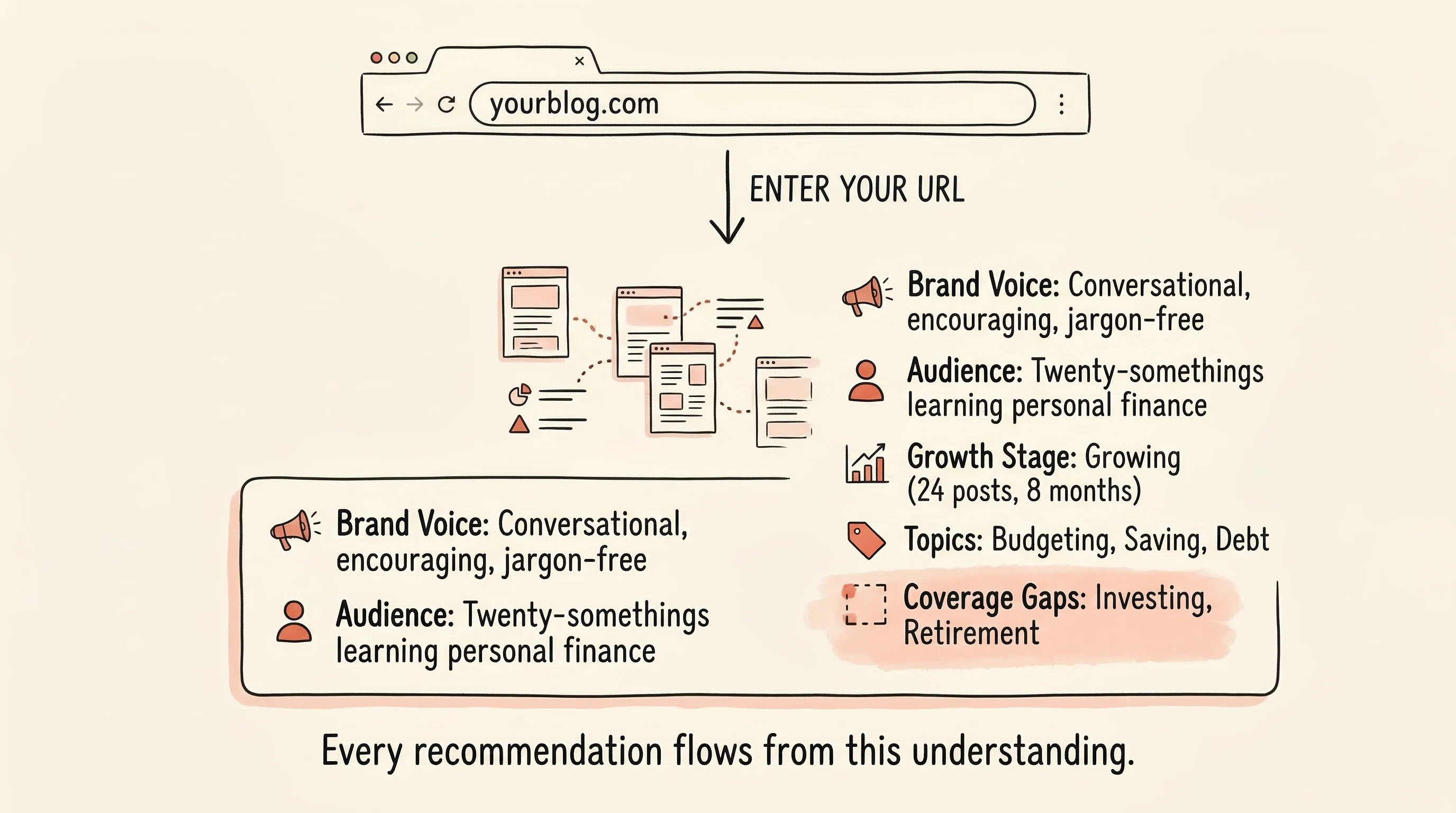
Your existing content. What have you already published? What topics have you covered? Where are the gaps? A tool that knows your blog won't suggest a topic you've already written about — and it will notice if you've built a cluster around budgeting but have nothing on investing, even though your audience cares about both.
Your growth stage. A blog with 24 posts and limited backlinks needs different keywords than one with 200 posts and established authority. The realistic opportunities are completely different. A keyword that's a smart play for an established blog is a waste of time for a new one.
Your voice and audience. Your blog has a specific tone, a specific reader. You write for twenty-somethings figuring out money for the first time, not for retirees managing portfolios. A tool that understands this filters suggestions toward your actual audience — not the broadest possible interpretation of your niche.
The foundation that makes everything else work
When SitePerfector learns your site, it does this automatically. You enter your URL. The system crawls your pages, maps your existing content coverage, extracts your brand voice from your writing, identifies your target audience, and assesses your growth stage.
This isn't a one-time questionnaire where you describe yourself in three sentences. It's a full analysis of what you've built so far — the kind of understanding that makes every downstream recommendation specific to you.
Keyword suggestions are filtered to your niche relevance and realistic opportunity. Content strategy recommendations account for what you've already published. Outlines are structured for your audience, not a generic reader.
The intelligence layer is invisible — you don't interact with it directly. You just notice that the suggestions actually make sense for your blog, instead of feeling like they were generated for someone else.
You can feel the difference
The shift is immediate. Instead of scrolling through 300 keywords trying to figure out which ones apply to you, you see a focused list where every suggestion has already been vetted against your blog's profile. Instead of guessing whether a keyword is too competitive, the tool already factored in your growth stage.
You spend your limited content time on the part that matters: choosing which topic resonates with you and writing something your readers will care about. Not on the part that shouldn't be manual: figuring out what's realistic for your blog right now.
That's the difference between a tool with data and a tool with understanding. See how SitePerfector builds that understanding.